# From spreadsheets to a software solution for CSRD
This articles explores the limitations of spreadsheets for CSRD compliance and highlights how transitioning towards dedicated software can streamline CSRD reporting.
Author: Anna Kuppel
Published: 2025-02-18
Source: https://www.coolset.com/academy/from-spreadsheets-to-a-software-solution-for-csrd
##### Key takeaways
Spreadsheets introduce significant risk for CSRD reporting through manual errors, version control issues, lack of audit trails and inability to produce XBRL-formatted outputs.
Dedicated CSRD software automates data collection, ensures compliance with ESRS standards and generates audit-ready reports with full evidence linking.
Coolset's CSRD platform replaces spreadsheet workflows with guided disclosures, automated compliance checks and XBRL export for mid-market teams.
The rollout of the Corporate Sustainability Reporting Directive (CSRD) is a major leap towards greater consistency and transparency of sustainability reporting across Europe. But it also brings new challenges for businesses still relying on old-school methods of data management.
For many mid-market companies, Excel or Google Sheets may feel like the easiest and most familiar option for CSRD reporting. But these tools come with significant drawbacks. As your sustainability data gets more complex and regulations demand greater accuracy, spreadsheets become more of a liability rather than a solution.
Read on to learn why spreadsheets fall short for CSRD reporting and how switching to a dedicated software can make compliance easier.
## Why sustainability managers are stuck in Excel for CSRD reporting
For many businesses, spreadsheets have long been the go-to tool for sustainability reporting. In fact, a 2024 KPMG survey found that nearly half of large companies still rely on them to manage environmental, social, and governance (ESG) data. And it's easy to see why. They're free, easy to set up, and don't require IT approval.
But as reporting grows more complex, these same companies are finding themselves stuck in inefficient, error-prone workflows. A Deloitte study revealed that 57% of executives cite data quality as their biggest ESG reporting challenge. So, it's clear traditional tools are no longer enough to meet today's rigorous disclosure requirements.
## How mid-market companies, specifically, suffer from this
Unlike large enterprises with dedicated sustainability teams and advanced software, mid-market companies often rely on smaller teams juggling multiple responsibilities. This makes spreadsheets an appealing short-term solution, but over time, they cause more problems than they solve. Here's why:
### 1. Spreadsheets are prone to human errors
A recent study found that 94% of spreadsheets used for business decision-making contain errors, with most stemming from human mistakes. A simple typo, incorrect formula, or formatting issue can distort emissions figures, financial disclosures, or key ESG metrics, leading to compliance risks, regulatory fines, and a lost investor trust.
### 2. Version control and data integrity issues
When multiple people edit the same spreadsheet, data can accidentally be overwritten, duplicated, or lost. Without a centralized system to track who changed what and when, teams can struggle to accurately track sustainability performance.
### 3. Not audit-ready
Under the CSRD, companies must obtain third-party assurance, and soon reasonable assurance (a stricter audit standard). But spreadsheets lack built-in audit trails, making it hard to verify the accuracy of sustainability data. This forces teams to manually track modifications, wasting precious time and making it harder to pass audits.
### 4. Limited automation
CSRD reporting involves handling large amounts of sustainability data, but spreadsheets aren't built for efficiency. Because every data entry, calculation, and validation step is manual, reporting becomes slow and time-consuming. As deadlines approach, teams get buried in tedious tasks that could be automated.
### 5. No real-time integration
Sustainability data comes from various sources: finance, HR, supply chain, etc. But spreadsheets can't sync with these systems in real time. In fact, 60% of finance executives struggle with ESG data scattered across unconnected applications. This forces teams to consolidate data manually, increasing inefficiencies and the risk of errors.
### 6. Not compliant with XBRL & ESEF
CSRD reports must be submitted in XBRL, a human- and machine-readable format, via the European Single Electronic Format (ESEF). This makes reports easier to standardize, validate, and compare across companies.
As spreadsheets do not natively support this format, companies must use add ons or workarounds to manually convert reports, increasing compliance risks and costly manual corrections.
### 7. Poor collaboration and workflow management
CSRD reporting requires input from multiple teams, yet spreadsheets lack built-in tools for workflow tracking, approvals, task assignments, or real-time updates. The result? Miscommunication, delays, and duplicated work.
### 8. Security and confidentiality risks
Spreadsheets can easily be duplicated, emailed, or saved on local drives, leading to data breaches and unauthorized access. Sensitive ESG data can be leaked or tampered with, putting companies at risk of compliance violations and reputational damage.
### 9. Struggles with large datasets
As datasets grow, spreadsheets struggle to process large volumes of information efficiently. Slow load times, frequent crashes, and formula errors make it difficult to maintain data accuracy. Excel's row and column limits further restrict analysis, forcing teams to break datasets into multiple files, adding complexity and increasing the risk of errors.
### 10. Inability to adapt to evolving ESG requirements
Spreadsheets lack the flexibility to accommodate evolving regulatory standards, new reporting frameworks, and expanding ESG metrics. As businesses scale their sustainability efforts, relying on spreadsheets becomes unsustainable, leading to inefficiencies and compliance risks.
## Moving from spreadsheets to a software solution for CSRD
While spreadsheets may seem like an easy way to manage sustainability data, as we've just learned, they can quickly become a burden. Switching to a dedicated CSRD software streamlines compliance, reduces errors, and saves your team valuable time. Here's how to make the transition:
### 1. Selecting the right software
According to Deloitte's 2024 Sustainability Action Report, 74% of companies plan to invest in new technology to enhance their ESG disclosure capabilities within the next 12 months. This makes choosing the right CSRD software even more important to stay competitive and compliant.
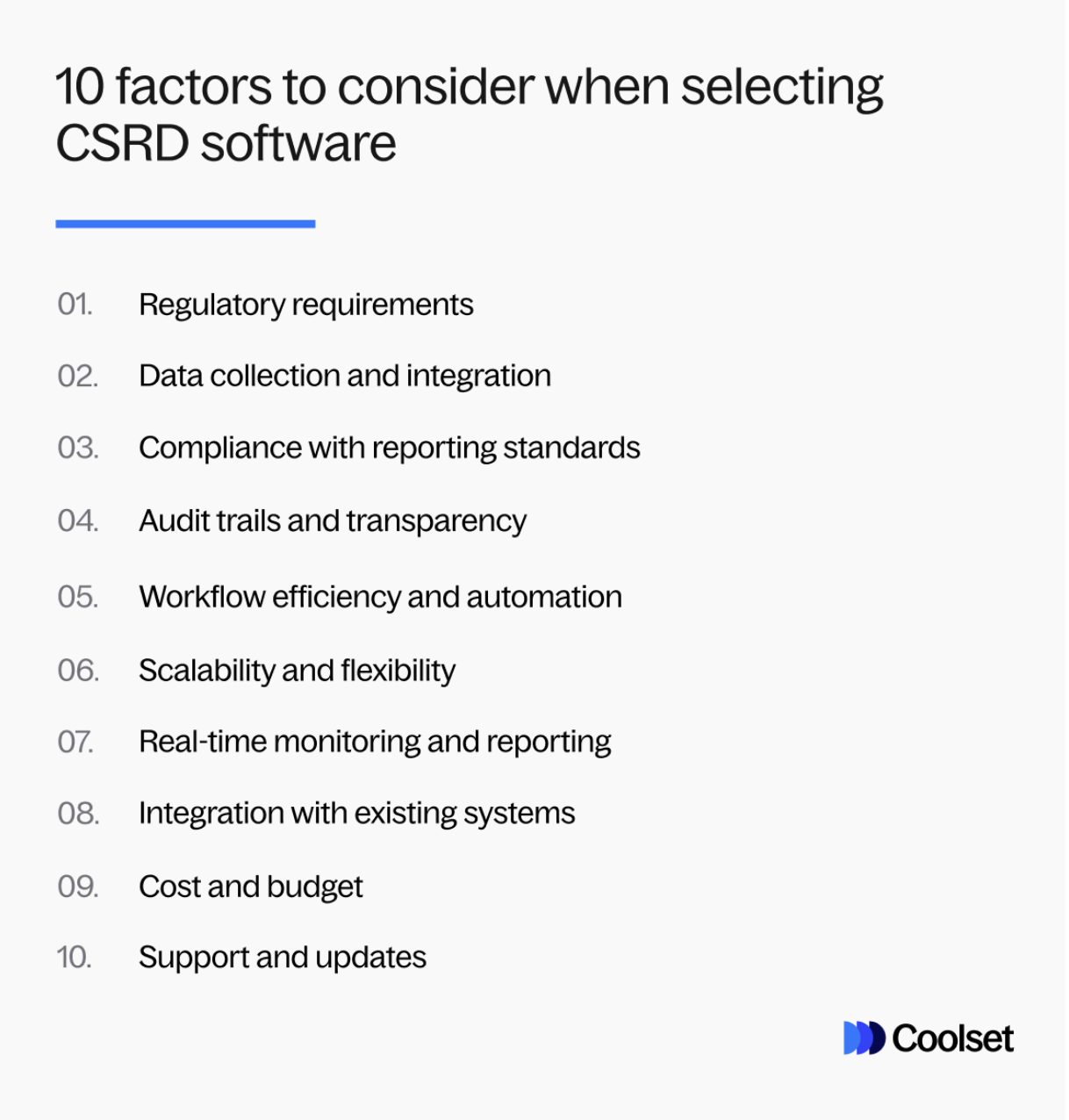
Our CSRD software buyer's guide (2025) walks you through exactly how to choose the best solution for your business. Here's a snapshot of the key factors to consider:
### 2. Integrate your new CSRD software with current systems
Sustainability data is spread across multiple sources: energy management, supply chain, travel, logistics, finance, and more. As each system uses different metrics and formats, consolidating this information manually into spreadsheets increases the risk of errors.
A good CSRD platform automates this process by pulling data directly from your existing tools. This not only saves you time but also improves accuracy across all sustainability metrics.
### 3. Say goodbye to frustrating, confusing, non-compliant spreadsheets
At the end of the day, spreadsheets simply weren't built for CSRD compliance. Version control issues, manual errors, and audit challenges make them risky for sustainability reporting.
By switching to a dedicated solution, you can eliminate manual data entry and reduce reporting errors, generate audit-ready reports effortlessly, and save time with automated workflows and compliance tracking.
## Why Coolset is a mid-market company's best bet for CSRD reporting
Spreadsheets may have been a practical solution in the past, but they are no longer fit for today's CSRD reporting needs. Businesses relying on them risk errors, inefficiencies, compliance failures, and audit issues.
Switching to Coolset for CSRD reporting ensures:
Ditch the hassle of spreadsheets and upgrade to smarter sustainability reporting today. Request a free demo today to see how Coolset can streamline your CSRD reporting before it's too late.