# No EUDR Delay - Practical steps to compliance by January 1
In a recent Coolset webinar, our research team clarified common misconceptions around the EUDR timeline. While the European Commission has proposed adjustments, the regulation is still moving forward, and companies should act accordingly. The session outlined five practical steps to get compliance-ready, with a focus on supplier data, internal coordination, and early testing.
Author: Elisavet Diamantopoulou
Published: 2025-11-11
Source: https://www.coolset.com/academy/no-eudr-delay-compliance-by-january-1
##### Key takeaways
The proposed EUDR delay applies only to SMEs, who have until December 30, 2026; large and medium operators must still comply with EUDR by December 30, 2025.
The proposed six-month grace period for large and medium operators affects penalties, not compliance obligations.
Businesses should focus on traceability, supplier engagement, and defendable due diligence.
Coolset helps centralize supplier data, test DDS workflows, and stay audit-ready.
During our recent EUDR readiness webinar, Coolset's research team confirmed that despite speculation, no general delay to the EU Deforestation Regulation (EUDR) has been approved.
The European Parliament continues to debate certain details, but until any legislative changes are formally adopted, companies should assume the current timeline still stands: operators and traders must comply from December 30, 2025, with full enforcement for micro and small primary operators following December 30 2026.
As discussed in the session, much of the confusion comes from headlines about a "delay." In reality, this refers only to a six-month grace period on penalties for large and medium operators (not on compliance itself).
The message from our experts was clear: don't panic, but don't pause. The regulation is still moving forward behind the scenes, and the companies taking proactive steps now will be best positioned to avoid disruption and demonstrate credibility to customers, investors, and regulators.
This article summarizes our recent webinar's key guidance into five short-term actions sustainability, procurement, and compliance teams can take to show progress and stay ahead of enforcement.
## What "no delay" really means for non-SME companies
For large and medium-sized companies, the compliance deadline remains December 30, 2026, while small and micro enterprises will follow a year later.
Although the European Commission has floated proposals to smooth enforcement, these are focused on giving national authorities and companies more time to adapt to new IT systems and processes, not on changing the core regulation itself.
The intent is to make the rollout more practical, for example by phasing in TRACES access, delaying penalties, or offering clearer guidance on risk classification, while keeping the original compliance dates intact.
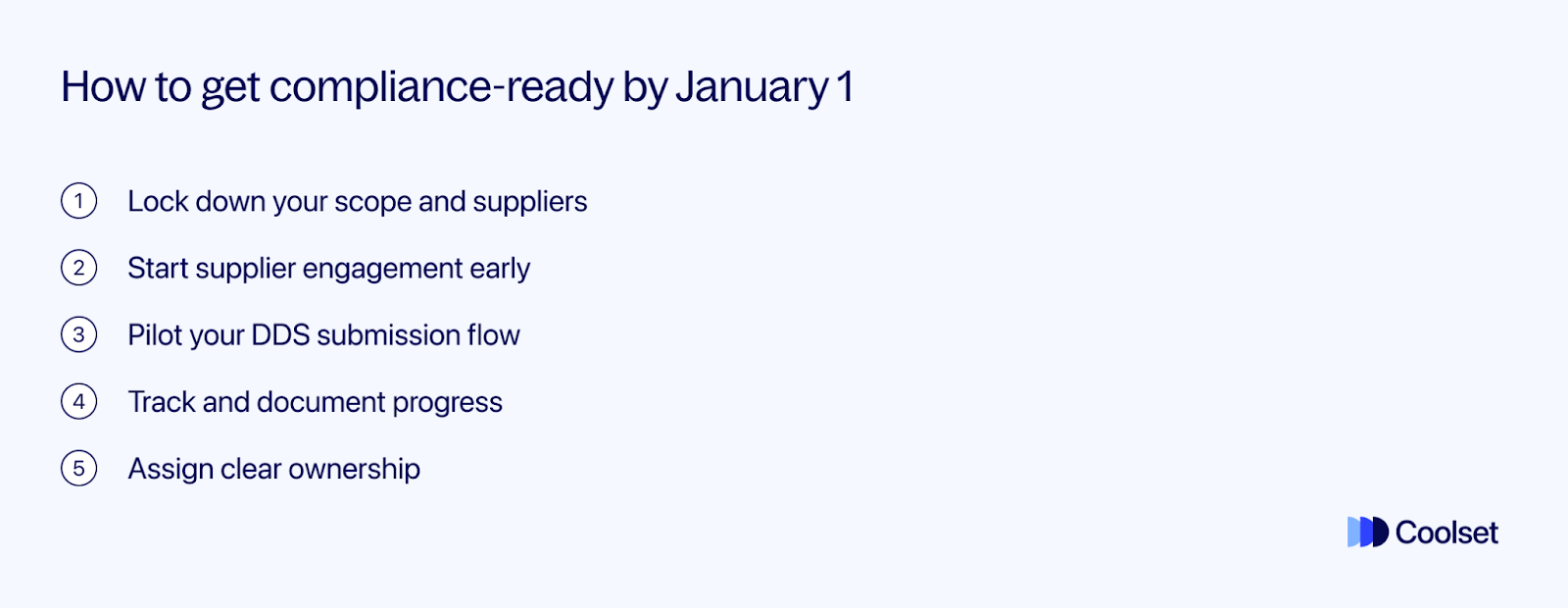
## Step-by-step: how to get compliance-ready by January 1, 2026
With the deadline approaching, there are five practical steps to demonstrate progress and reduce compliance risk, even as the details of enforcement evolve.
Remember: You don't need perfection by January 1, just a defendable process.
### 1. Lock down your scope and suppliers
Confirm which products fall under Annex I and identify their HS codes. Then map your key suppliers, prioritizing the suppliers or commodities that make up the majority of your import volume or risk exposure.
### 2. Start supplier engagement early
Begin by explaining why this data is needed. We recommended using simple templates or translation support to help suppliers share coordinates and legality documents without friction. Don't wait for TRACES access, data gathering can start now.
### 3. Pilot your DDS submission flow
Run a small-scale test of your Due Diligence Statement (DDS) with one or two representative shipments. Even if the TRACES portal isn't yet open, simulate the process internally to identify missing fields and communication gaps between procurement and compliance.
### 4. Track and document progress
Create a basic dashboard or spreadsheet to track supplier responses, DDS completeness, and data quality. This becomes your evidence base showing "reasonable steps" toward compliance if authorities request proof of preparation.
### 5. Assign clear ownership
Designate one person or small team responsible for coordinating EUDR readiness across data collection, verification, and DDS sign-off. Embedding this responsibility within your ESG or internal control process helps prevent last-minute confusion.
## What to collect and how to prioritize
With less than two months to go, companies should focus on collecting the minimum viable information that proves traceability and legality for each in-scope shipment. The goal isn't to have flawless datasets, it's to show a clear, defensible process.
### Start with the essentials:
Geolocation: coordinates or polygons for every plot of origin
Production date or harvest period: proof of when the material was produced
Legality documentation: land titles, harvest permits, or other local proof of ownership and legality
DDS references: for traded materials already covered by another operator's statement
Start small: trace one or two complete supply chains end-to-end to test your data flow. Even if formats or templates evolve, focus on keeping records consistent, verifiable, and linked to supplier identities.
Use public tools like FAO Forest Watch to check land-use data and the TRACES sandbox (when available) to understand submission workflows. You can reach out to your national competent authority for country-specific compliance guidance.
Coolset's EUDR module can also help you manage supplier input, automate version tracking, and ensure data remains audit-ready.
## How tools like Coolset help you move faster
Put simply: Excel won't get you through EUDR. Manual tracking using spreadsheets might work for a handful of suppliers, but it quickly breaks down when dealing with hundreds or thousands of data points.
Digital compliance tools can save weeks of preparation time by automating traceability mapping, supplier communication, and DDS generation, all within a single system. The goal isn't to add another layer of software, but to make data collection faster, clearer, and audit-ready.
With Coolset's EUDR compliance platform:
Suppliers can enter data directly through multi-language forms, without needing separate logins.
The platform captures geolocation and legality documentation in structured form and automatically generates TRACES-ready DDS files.
Built-in checks flag missing information and maintain version control, so every change is traceable.
When evaluating tools, we recommended focusing on:
Interoperability: integration with your ERP, accounting, or ESG systems
TRACES synchronization: readiness to export or submit DDSs directly
Multi-tier data capture: the ability for all supplier levels to contribute without extra licensing barriers
These features will help your teams reduce back-and-forth communication, minimize data errors, and maintain continuous compliance.
You can see Coolset's EUDR platform in action by booking a demo today.
## FAQs
Let's take a look at some of the most common uncertainties raised in the webinar around EUDR readiness.
### What happens if the Commission's proposed delay is later adopted?
Any delay would simply shift timelines, not the core requirements. All preparation you're doing now, from supplier onboarding to DDS drafts, remains valid under any updated schedule.
### Do I need to submit a DDS before the IT system is live?
No. Submissions will only be required once the TRACES portal officially opens for EUDR. However, we encourage companies to prepare draft DDS files internally and run mock submissions now to be ready for upload on day one.
### Can I reuse upstream DDS data as an operator or trader?
Yes. If a supplier or upstream operator has already created a DDS for the same batch, you can reference their statement ID rather than duplicate it. But remember: each operator remains responsible for confirming the accuracy and completeness of their own records.
### How should I handle suppliers who refuse to share coordinates?
Geolocation is a legal requirement, not a company preference. We recommend explaining this clearly and offering practical support. For example, through a platform like Coolset, which provides localized onboarding and step-by-step guidance. If suppliers remain unresponsive, the only real option is to change suppliers.