# The 5 qualitative characteristics of CSRD reporting (Updated Mar 2026)
This article recaps the core elements of the CSRD and explains the five qualitative characteristics your sustainability data needs to meet.
Author: Anna Kuppel
Published: 2026-03-19
Source: https://www.coolset.com/academy/qualitative-characteristics-csrd-compliant-reporting
##### Key takeaways
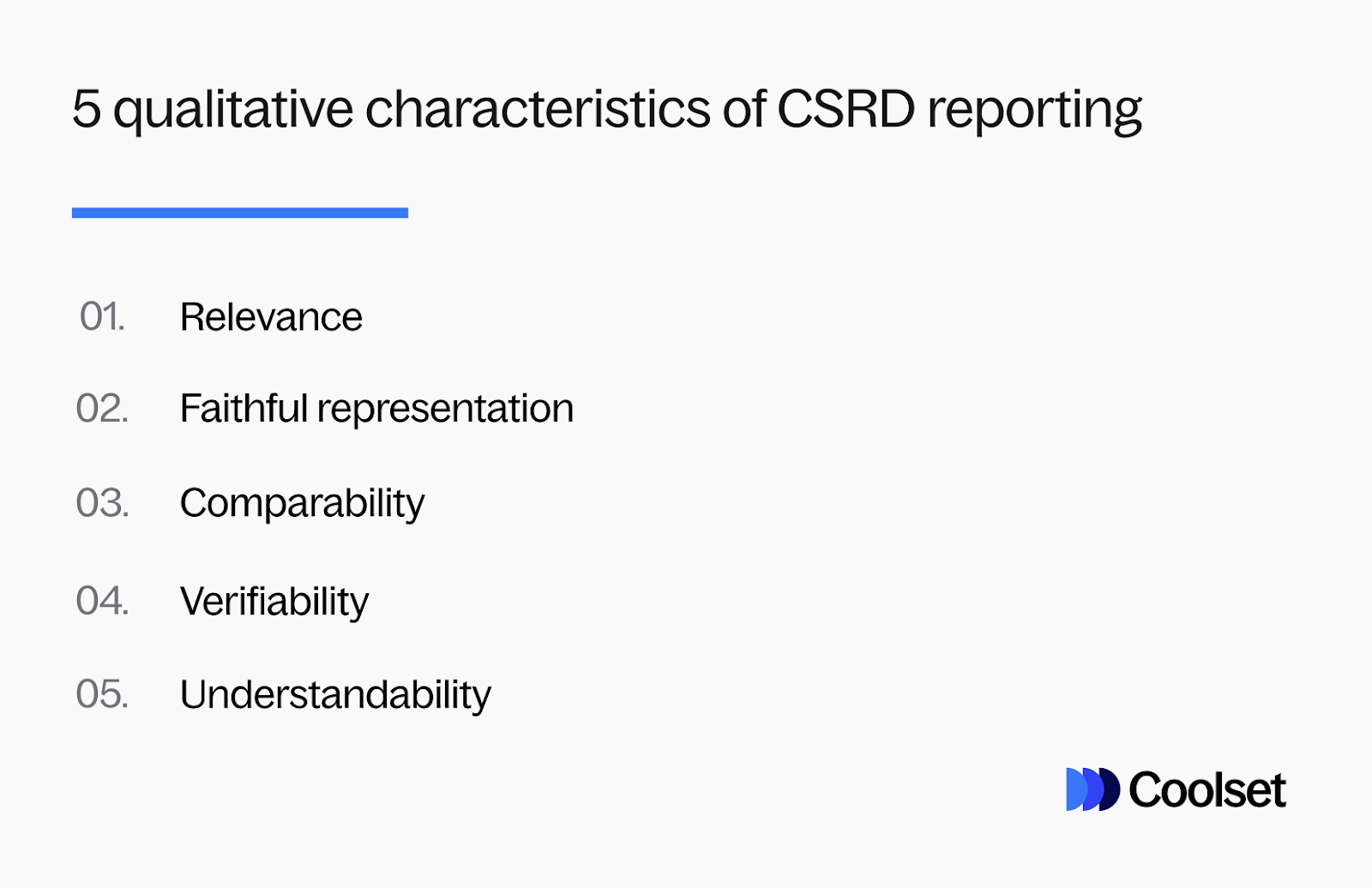
CSRD disclosures must meet five qualitative characteristics: relevance, faithful representation, comparability, verifiability and understandability.
Failing to meet these standards leads to costly rework, higher audit fees and potential qualified opinions that undermine stakeholder trust.
Coolset's CSRD platform structures data collection and disclosures to align with all five characteristics, reducing revision cycles and audit costs.
Complying with the Corporate Sustainability Reporting Directive (CSRD) involves more than just gathering data–it's about making sure your sustainability information is both credible and meaningful for those who use it.
To make this easier, the CSRD defines five essential qualitative characteristics that your disclosures must adhere to: relevance, faithful representation, comparability, verifiability, and understandability. These standards ensure your sustainability data is audit-proof, reliable, and valuable for all stakeholders.
Failing to meet these standards can lead to costly delays and rework. By aligning your reporting with these characteristics from the start, you can avoid time-consuming revisions and keep compliance costs down.
This article will recap the core elements of the CSRD and explain the five qualitative characteristics your sustainability data needs to meet.
## CSRD, ESRS, double materiality assessments: how do these relate to each other?
Before we dive into the five qualitative characteristics, let's quickly recap some of the key elements under the CSRD umbrella.
### The Corporate Sustainability Reporting Directive (CSRD)
The CSRD is the EU's updated framework for enhancing transparency and accountability in corporate sustainability reporting. It replaces and expands upon the previous Non-Financial Reporting Directive (NFRD), offering investors and consumers a clearer way to assess and compare corporate environmental, social, and governance (ESG) impact.
Introduced under the European Green Deal, the CSRD supports the EU's goal to become the first climate-neutral continent by 2050 and keep global warming below 1.5°C, in line with the Paris Agreement.
### The European Sustainability Reporting Standards (ESRS)
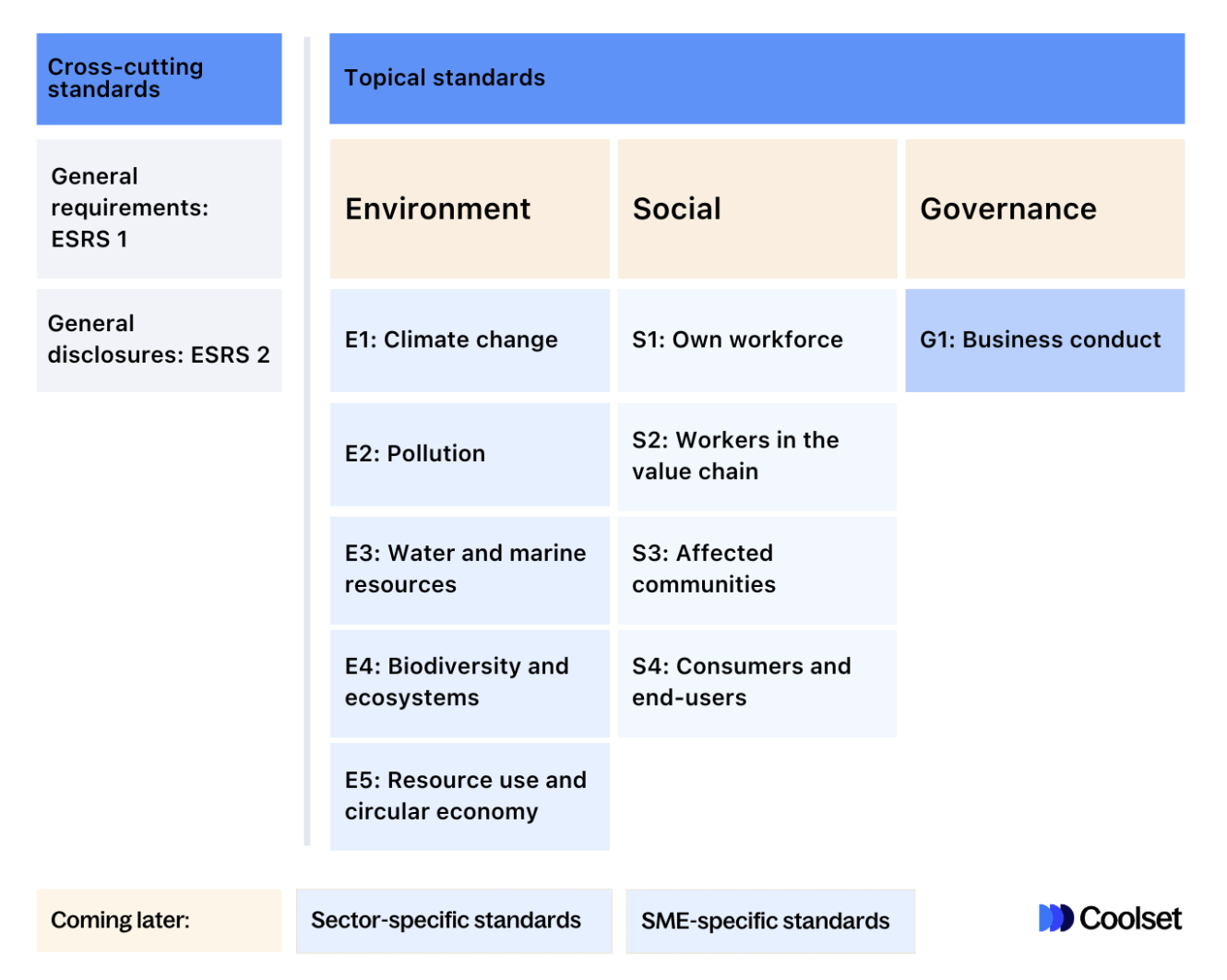
The ESRS forms the governing framework of the CSRD. These standards set out the specific reporting requirements for companies, ensuring sustainability reports are comparable, accurate, and meaningful.
There are 12 standards in total, 10 of which focus on specific ESG topics. The remaining two cross-cutting standards provide general guidance for disclosure, applicable to all companies. Under the amended ESRS, the number of required data points has been reduced significantly, though the five qualitative characteristics remain unchanged.
Sector-specific standards were originally planned for adoption by June 30 2026, but the Omnibus I Directive (adopted February 2026) removed the requirement for mandatory sector-specific ESRS. Instead, the European Commission may publish non-binding sector-specific guidance to help companies apply the cross-sector standards.
### The double materiality assessment
The double materiality assessment is the mandatory first step in CSRD compliance (see also: how to conduct one in 2026). It helps you identify which of the 10 topical standards should be included in your reports.
Topics can be material based on their impact on your business's financial performance (financial materiality), their effect on society and the environment (impact materiality), or both.
By evaluating your business through these dual lenses, you ensure that the disclosed information reflects what truly matters to both your business and its stakeholders.
## Data quality requirements: 5 qualitative characteristics of CSRD reporting
After identifying your material topics, the next step is gathering the necessary data and preparing your report. Keeping the CSRD's disclosure qualities in focus throughout the compliance process - including the double materiality assessment - ensures your reports are reliable and audit-proof.
Now, let's take a look at the five qualitative characteristics in more detail:
### 1. Relevance
The first qualitative characteristic of CSRD data is relevance. Relevant information should have the capacity to influence assessments and decisions, whether it's helping stakeholders predict future outcomes or confirming or changing past evaluations.
This means your data should be open, transparent, and clearly communicate sustainability matters, taking into account the context and importance of the information provided.
### 2. Faithful representation
Faithful representation means showing things as they really are. Information provides a faithful representation of reality if it is complete, neutral, and accurate.
A complete disclosure covers all material information related to the topic, with appropriate descriptions and explanations, giving users what they need to make informed decisions.
Neutrality means presenting the facts without bias, providing a balanced view of risks, opportunities, and impacts–-avoiding a skewed focus on either positive or negative aspects.
Accuracy means your data should be clear, without netting or compensating figures, and clearly highlighting estimates and their limitations. While accuracy doesn't need to be perfect, the information should be as close to reality as possible.
The qualities of comparability, verifiability, and understandability also help to make the data more useful.
### 3. Comparability
Comparability boosts the usefulness of your information by ensuring it's consistent over time, and can be easily compared across and within sectors. Your data should align with a reference point like a baseline, target, or industry benchmark, and use consistent reporting methods year after year.
In sustainability reporting, both raw data and normalized data should be prioritized because they offer clear and fair comparisons. Relative data like percentages still has value, even though it's not as comprehensive on its own.
### 4. Verifiability
Sustainability information is verifiable if it allows users to trust the data that informs their decisions, allowing different independent observers with reasonable expertise to reach similar conclusions. Verifiable information should be traceable and auditable, with clear documentation of the processes and methods used to produce the information.
### 5. Understandability
Understandable information is presented clearly and concisely, enabling users to grasp the main points. It should be laid out in easy-to-follow formats like tables, graphs, and diagrams alongside narrative text to highlight key aspects.
Even complex information should be presented as clearly as possible. Avoid unnecessary jargon and abbreviations, and include units of measurement to keep information accessible.
## Speed up your CSRD compliance journey with the right software
As you can see, CSRD compliance involves much more than just gathering data - it's about ensuring your sustainability information is reliable, and useful for all stakeholders involved. By keeping the five quality standards top of mind from the start, you can avoid costly delays and ensure your disclosures meet stakeholder expectations.
To make this process more efficient, Coolset's sustainability management software automates every step of your CSRD compliance journey.
Pre-built surveys guide you through the double materiality assessment with results visualized on a materiality matrix. Based on these outcomes, the software unlocks only the relevant ESRS disclosures, so you avoid wasting time gathering data you don't need.
With curated suggested answers and the ability to attach supporting evidence, you can finalize your report quickly and export it in the required .XBRL format, ready for audit.
Ready to get started? Try Coolset for yourself below, or request a free personalized walkthrough from one of our product experts today.