# Which products are covered under the EUDR? A sector-by-sector overview (Updated June 2026)
Understand how to classify commodities and products under the EUDR before 2025 enforcement. Learn which primary commodities - cattle, cocoa, coffee, oil palm, rubber, soy, and wood - and their derivatives are in scope and where they’re commonly misclassified. Use this guide to map portfolios, trace supply chains, and apply due diligence to stay audit-ready.
Author: Elisavet Diamantopoulou
Published: 2026-03-20
Source: https://www.coolset.com/academy/which-products-are-covered-under-the-eudr-sector-by-sector-overview
##### Key takeaways:
Check if your products contain cattle, soy, palm oil, cocoa, coffee, rubber, or wood, and match their CN codes against Annex I to confirm if EUDR applies.
Focus your efforts where risk and complexity are highest - like smallholder-based cocoa or blended coffee supply chains — and start collecting geolocation and legality data now.
Coolset links your product and supplier data to EUDR obligations, making it easy to classify goods, track compliance, and generate DDS files ready for EU audits.
## Introduction
The EU Deforestation Regulation (EUDR) targets seven of the world's leading drivers of deforestation: cattle, soy, palm oil, coffee, cocoa, rubber, and wood. These commodities are restricted from EU trade unless they are proven to be deforestation-free and legally produced. Together, they account for around 40% of tropical deforestation globally, much of it driven by international demand.
One striking example is the cocoa industry in Côte d'Ivoire, where between 2000 and 2019, forestland larger than half the size of the Netherlands was replaced by cocoa plantations.
With enforcement set for 30 December 2026 for large and medium operators (and 30 June 2027 for micro and small operators), understanding which products are covered is one of the most urgent compliance steps. For a full overview of EUDR due diligence requirements, see our dedicated guide. The European Commission has confirmed it will not reopen the core EUDR text, meaning the product scope is now stable and preparation should continue.
This guide breaks down the EUDR's product scope, why these commodities were selected, which product types fall in or out of the scope of the regulation, and what this means for your sector. Whether you trade in bulk soy or finished leather goods, knowing how your goods fall under the EUDR scope is key to acting early and staying ahead.
## What the EUDR regulates at a glance
The EUDR applies to seven key commodities linked to deforestation and forest degradation:
Cattle
Palm oil
Soy
Cocoa
Coffee
Natural rubber
Wood
These commodities, and a defined list of products made from them, can only be traded into or out of the EU if they are proven to be both deforestation-free and legally produced.
Deforestation-free means the land used to produce the commodity was not deforested or degraded after 31 December 2020.
Legal means the product complies with all applicable laws in the country of production, including those related to land use rights, labour conditions, and environmental protection.
Same rules, regardless of commodity
The regulation applies the same due diligence obligations across all commodity types. Whether you import coffee beans or timber, the due diligence obligations are identical: collect data, assess and mitigate risks, and submit due diligence statements (DDS) before placing products on the EU market.
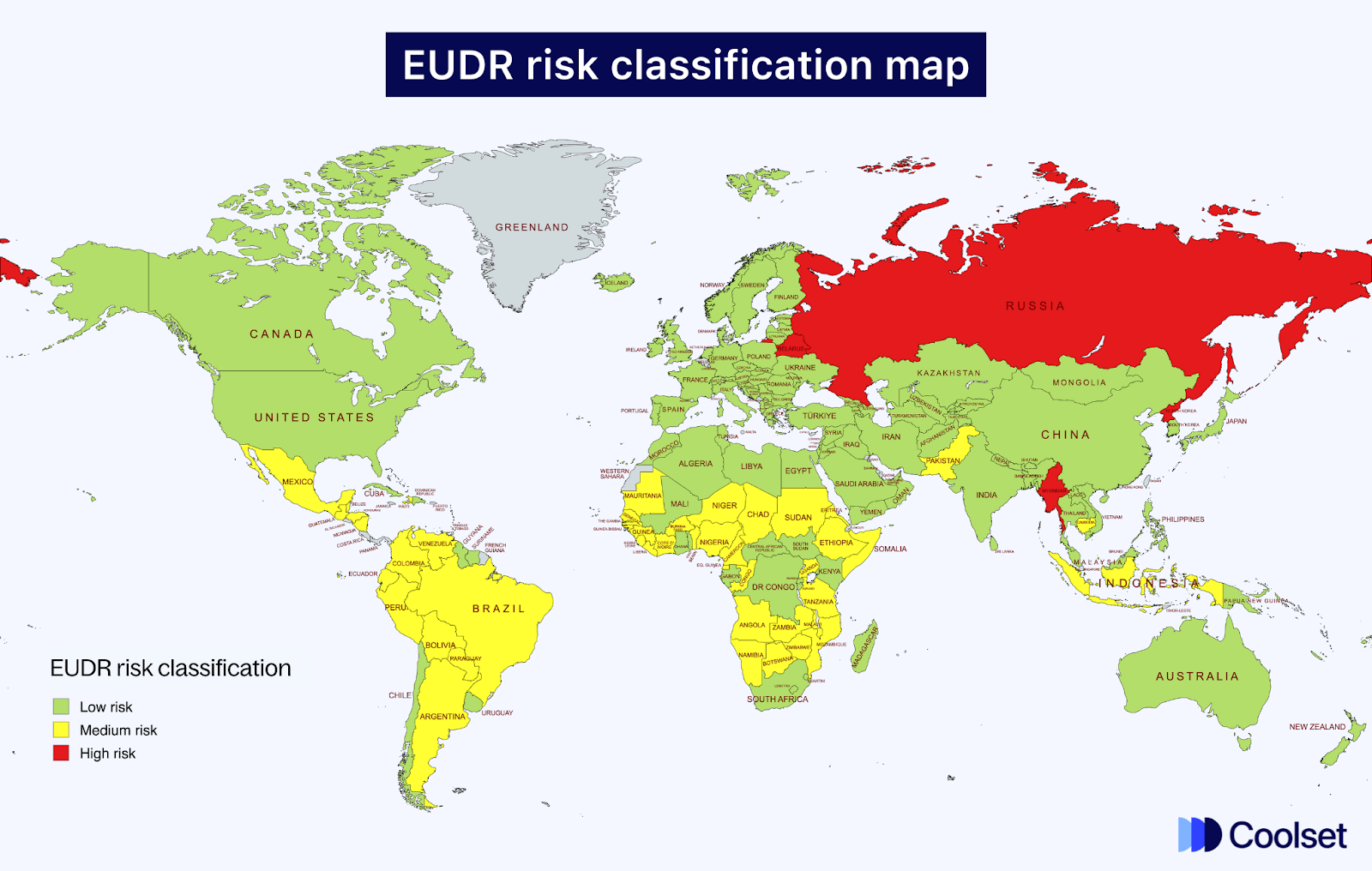
Good to know: A simplified due diligence process may apply if you source from low-risk countries based on the EU Benchmarking.
For multi-ingredient products, only the main commodity matters
Each product is regulated under a single Harmonized System (HS) and Combined Nomenclature (CN) code, determined by its primary component or function. If a product contains multiple EUDR commodities, only the one defining its classification is subject to due diligence.
## Understanding the Annex I product list
To determine whether your products are regulated under the EUDR, you need to check if they appear in Annex I of the regulation. Annex I defines the product scope using CN codes (Combined Nomenclature), the European Union's official product classification system.
CN vs HS codes: what you need to know
CN codes are 8-digit classifications used in EU customs systems. They are built on the international Harmonised System (HS), which uses 6 digits. All CN codes start with an HS code, with the last two digits providing more detailed classification specific to the EU.
While Annex I lists CN codes,in the due diligence statement you submit must report the first 6 digits, that is, the HS code.
How product classification works
Product classification is based on the item's main purpose, material, or form. This classification determines its customs code, which in turn defines whether the product falls under EUDR scope.
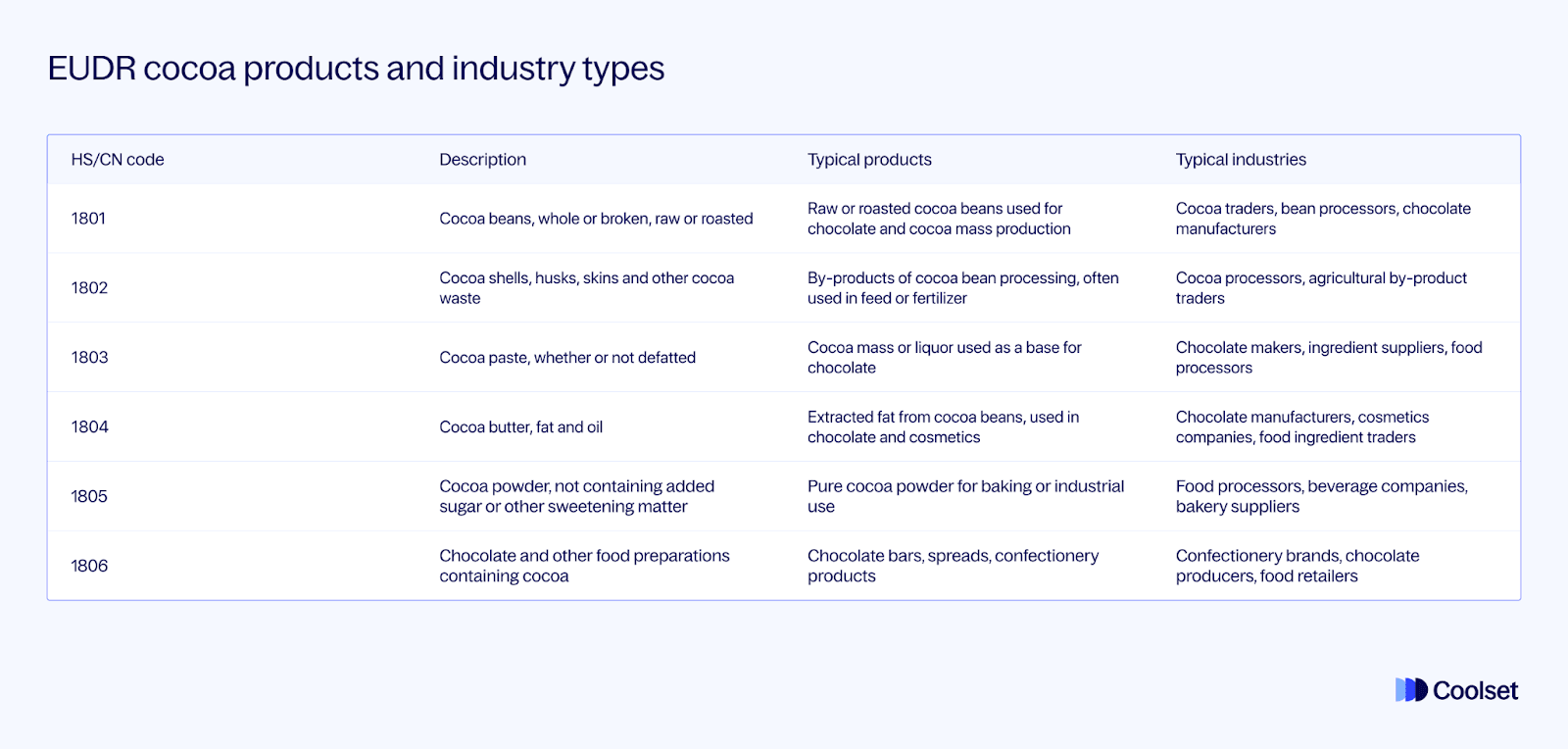
For example, a chocolate bar is classified under HS code 1806 ("chocolate and other food preparations containing cocoa") because cocoa is the main ingredient. Even if the bar contains palm oil, it is not considered a palm oil product for regulatory purposes. Due diligence applies only to the cocoa.
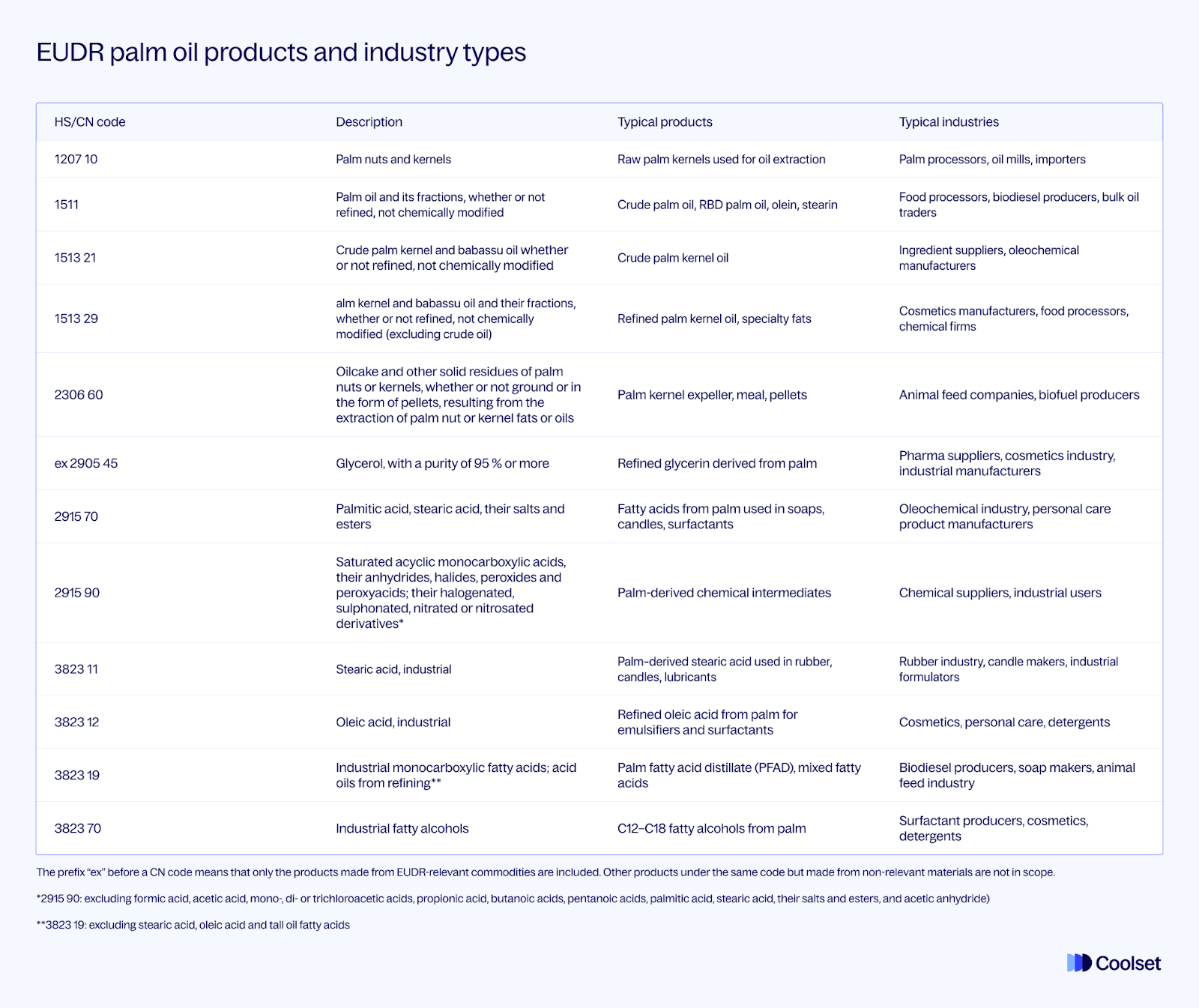
In contrast, crude palm oil is classified under HS code 1511, which is explicitly included in Annex I, meaning it is in full scope. Refined palm oil products, such as cooking oil made entirely from palm oil, would also fall under this classification.
A bar of soap made with palm oil, however, is classified under HS code 3401 ("soap and organic surface-active products"), which is not listed in Annex I. Despite palm oil being an input, the product itself is not regulated under the EUDR because its classification is based on its final form and primary function, not its ingredients.
Watch for "ex" markings in Annex I
Lastly, some CN codes in Annex I are marked with "ex", which signals that only a subset of products under that code are covered, specifically, those derived from EUDR-regulated commodities.
For example:
"ex 0201" covers beef from cattle, but not meat from pigs or poultry.
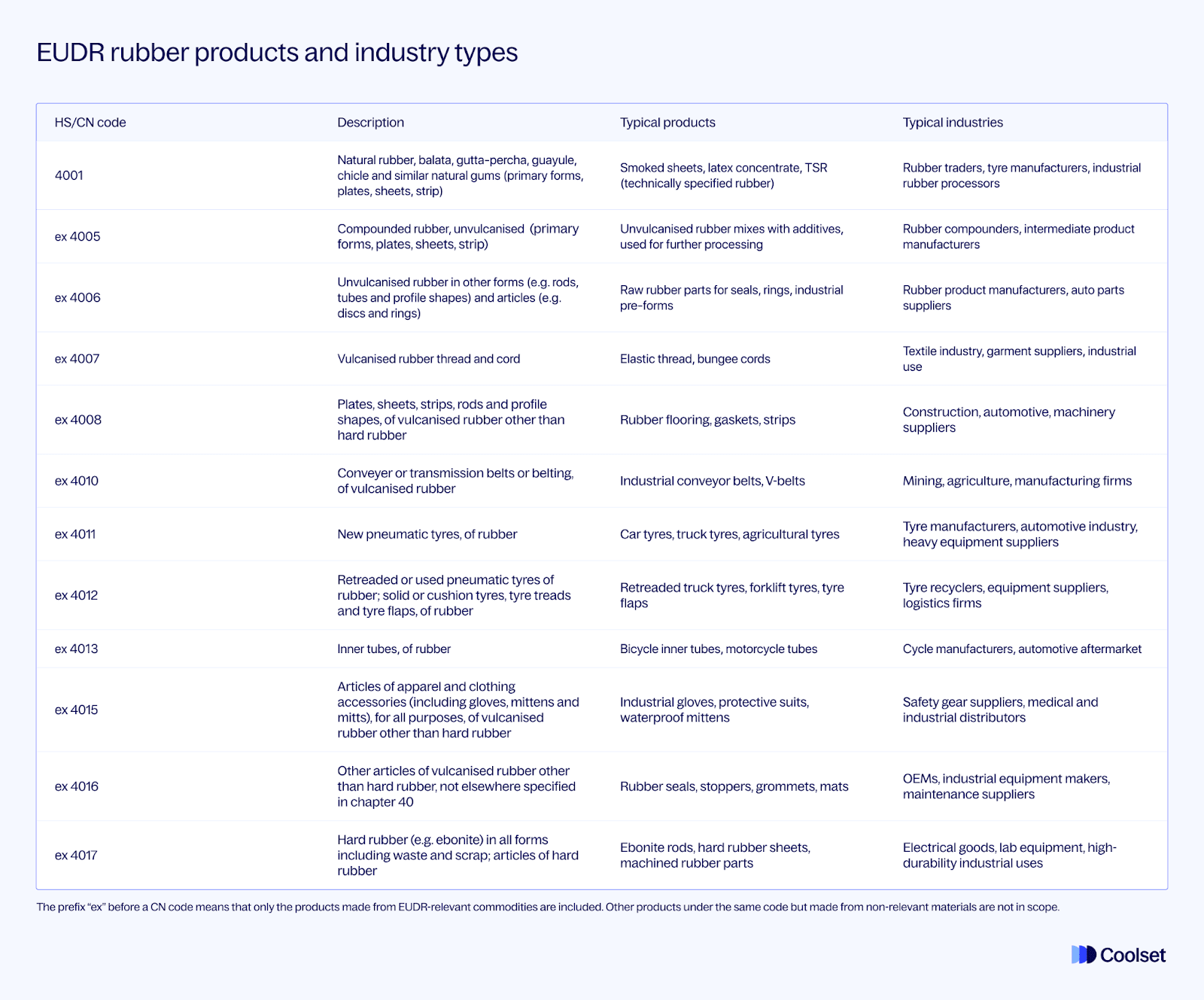
"ex 4011" covers tyres made from natural rubber, but not from synthetic rubber.
In these cases, businesses must confirm not just the CN code, but also whether the product is derived from a relevant commodity.
## Latest developments: What changed in December 2025 and what's next
In December 2025, Regulation (EU) 2025/2650 was published, formally postponing EUDR enforcement and introducing several simplifications to product scope and operator obligations:
Printed products removed from scope. All products under CN Chapter 49 (books, newspapers, periodicals, printed pictures) are no longer regulated under the EUDR.
"Ex" prefix clarifications added. Several CN code entries in Annex I now carry an "ex" prefix, confirming that only products derived from EUDR-regulated commodities are in scope under those codes.
Simplified operator obligations. Only the first operator placing a product on the EU market must submit a full due diligence statement. Downstream operators can reference the original DDS number. Micro and small primary operators may submit a simplified one-off declaration.
Waste, second-hand goods, and samples excluded. These categories are now explicitly confirmed as out of scope.
Update: Annex I delegated act adopted 13 July 2026
The European Commission adopted a delegated act amending Annex I on 13 July 2026, following the draft published for feedback on 4 May 2026. It removes cattle leather (HS 4101, 4104, 4107) from scope and adds soluble coffee and a range of palm oil derivatives. The act is not yet in force — it is subject to a Parliament and Council scrutiny period, and the current Annex I remains binding until then. See the full breakdown for details.
## Covered sectors: what's in and what's out
### Coffee
All major forms of coffee are in scope, green beans, roasted beans, ground coffee, and instant coffee.
Coffee-flavoured drinks, syrups, and candies may not be in scope if they're classified differently and coffee is not the defining ingredient.
Note: Instant coffee (soluble coffee, HS 2101 11 00) was added to Annex I by the delegated act adopted on 13 July 2026. It is not yet in force, pending Parliament and Council scrutiny, and compliance for this newly added product is required from 30 December 2027. Companies trading instant coffee should monitor Commission updates closely.
Sector nuance
For coffee, the main EUDR challenge is operational. Supply chains often involve large numbers of smallholder farms, making plot-level geolocation data difficult to obtain especially when records are informal or not digitized.
Operators will need to work closely with exporters and cooperatives to obtain this information, and may need to invest in digital tools or field-level support to get it reliably.
The widespread use of multi-origin blends adds a second layer of complexity. Traceability systems must ensure that batches do not mix beans with and without valid due diligence particularly as sourcing regions shift seasonally. Without clear segregation and documentation processes, companies risk losing visibility and falling out of compliance.
Global footprint and production dynamics
Coffee is grown in over 75 countries, making it one of the most globally dispersed EUDR commodities. Small-scale farms account for roughly 60% of global production, while mid and large scale producers make up the remaining 40%.
Small scale exporters are concentrated in countries like Vietnam, Indonesia, Ethiopia, Colombia and Honduras. Vietnam alone sources nearly 95% of its production from smallholder farms, primarily focused on Robusta coffee (FAO). Average plot sizes in the most productive regions are estimated at 1.3 hectares only.
In contrast, major large-scale producers are mainly based in Brazil, with smaller concentrations in Colombia, Honduras and Peru. They typically grow Arabica coffee on plots ranging from 10 to even 10,000 hectares, showing the large variation in plot sizes.
### Cocoa
Cocoa is fully in scope under the EUDR. From raw cocoa beans, to cocoa paste, butter, and powder, through to chocolate and other food preparations containing cocoa. If you import or export cocoa or chocolate as a finished good, due diligence applies.
Products that only contain small amounts of cocoa, such as chocolate-coated biscuits, may be classified under different CN codes (e.g. bakery goods) and are not covered, even if they contain deforestation-linked cocoa.
Sector nuance
For cocoa, EUDR compliance will likely hinge on how well companies can trace fragmented, smallholder-based supply chains, particularly in West Africa and Latin America. Plot-level geolocation data may be incomplete or hard to collect across multiple tiers, especially where supplier relationships are indirect.
Confectionery and branded food companies should focus their due diligence efforts on products classified under CN 1806 as classification, is not ingredient based, and CN codes determine whether EUDR due diligence is required.
Global footprint and production dynamics
Cocoa production is driven by smallholder farmers, with more than 90% of farms covering less than 5 hectares. The bulk of global supply comes from countries like Côte d'Ivoire, Ghana, Nigeria, and Indonesia, regions where cocoa cultivation is deeply tied to local livelihoods. While large-scale farms play only a minor role in the sector, Brazil stands out as a notable exception, contributing most of the cocoa that comes from larger scale operations
### Palm oil
Palm oil is covered in raw and refined forms, crude palm oil, palm kernel oil, palm oilcake, as well as certain palm-based chemicals and industrial derivatives. These are typically used in food processing, cosmetics, detergents, and biofuels.
Finished consumer goods made with palm oil, such as snacks, are currently not in scope unless their CN code appears in Annex I. However, a delegated act adopted on 13 July 2026 adds a range of palm oil derivatives, including soap forms, to Annex I; it is not yet in force, pending Parliament and Council scrutiny. Companies trading palm oil-based soap should monitor Commission updates closely.
Sector nuance
For palm oil, the key EUDR challenge lies in traceability beyond the refinery. Many EU buyers source from integrated traders or refiners, but these facilities often aggregate supply from dozens, sometimes hundreds of mills, each sourcing from a wide mix of plantations and smallholders.
Without mill-level or plantation-level traceability, operators risk falling short on the regulation's geolocation and deforestation-free requirements. Even when suppliers are RSPO-certified or operating in low-risk regions, documentation must still meet EUDR's specific data standards.
Companies should also pay close attention to product classification: while crude and refined palm oils are clearly listed in Annex I, many downstream products that contain palm oil, including margarine, soap, and personal care items, are not. This means that due diligence is required only for specific commodity codes. Getting classification wrong could lead to unnecessary compliance effort or overlooked legal exposure.
Global footprint and production dynamics
Roughly 60% of global palm oil production comes from large-scale estates, primarily located in Indonesia and Malaysia. These plantations typically range from 3,000 to 10,000 hectares in size. The remaining share is produced by smallholders in the same regions, where the legal maximum for small-scale farms is 40 hectares. In Thailand, smallholders play an even more dominant role, accounting for up to 90% of production, with average plot sizes around 8 hectares
### Soy
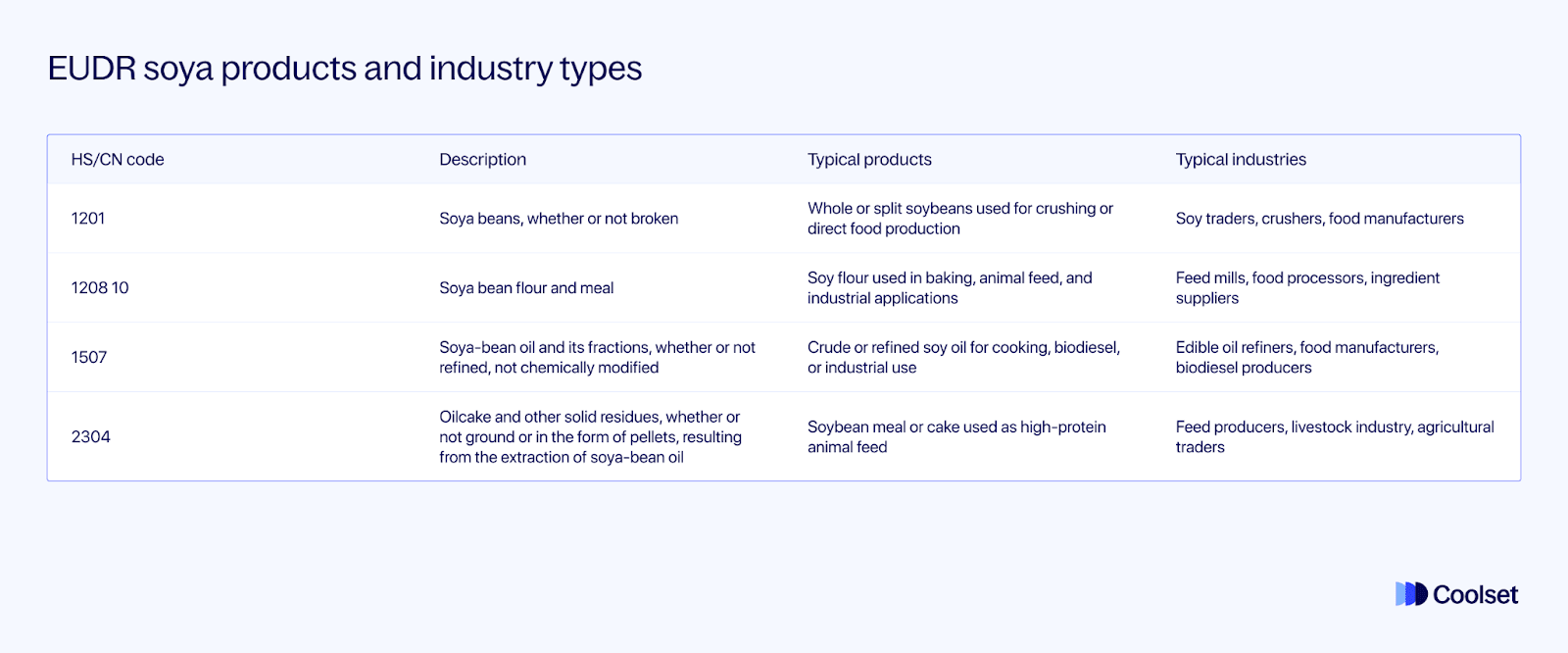
Soy is in scope when traded as beans, oil, flour and meal, or soy oilcake. These are core ingredients in feed and edible oil markets.
Derived products such as tofu, soy sauce, or meat alternatives made with soy are typically out of scope, as they fall under CN codes not listed in Annex I.
Sector nuance
Soy supply chains also present traceability challenges. Sourcing often involves large commodity traders and indirect links to producers, with limited visibility at farm level. Geolocation data may not be readily available, especially when soy is aggregated at crushing or export terminals. Buyers will need to strengthen traceability expectations with suppliers or shift to sourcing arrangements that provide EUDR-compliant data.
It's also important to distinguish what's not in scope. Processed foods that contain soy, such as tofu, soy sauce, or plant-based meat alternatives, are typically classified under general food codes and do not appear in Annex I. Products made from soy-fed animals (poultry, pork, fish, eggs) are also excluded.
Global footprint and production dynamics
Brazil, the United States, and Argentina are among the world's leading producers of soy. In these countries, more than 80% of production comes from large-scale farms, typically ranging from 500 to 5,000 hectares. In Brazil, however, there are notable regional differences. While the southern region is characterized by smallholders with average farm sizes of around 35 hectares, the Midwest is dominated by large estates
### Natural rubber
Natural rubber is in scope both in raw form and in many rubber-based products, like tyres, hoses, belts, and gloves, when they are made from natural rubber. Rubber-based products like synthetic tyres or recycled rubber are not included.
Sector nuance
For rubber, EUDR compliance depends on two things: whether the product is classified under a listed CN code, and whether it contains natural (not synthetic) rubber. Many commonly traded products are listed under "ex" codes in Annex I, meaning they're only in scope if made with natural rubber. Importers must be able to verify this and document it.
Traceability is another critical challenge. Finished goods often pass through multiple processors, and natural rubber is typically aggregated from thousands of smallholders. Without direct supplier links or upstream traceability systems, collecting compliant geolocation data at farm level may be difficult.
Companies relying on large traders or pre-assembled components will need to build controls that ensure natural rubber inputs are EUDR-aligned before import.
Global footprint and production dynamics
More than 85% of global natural rubber production comes from smallholder farmers, most of whom manage plots smaller than 5 hectares, typically between 2 and 3 hectares. This small-scale structure is a defining feature of the sector, particularly in Southeast Asia, which accounts for the majority of global exports. The leading producers and exporters include Thailand, Indonesia, Vietnam, and Malaysia.
### Wood and timber
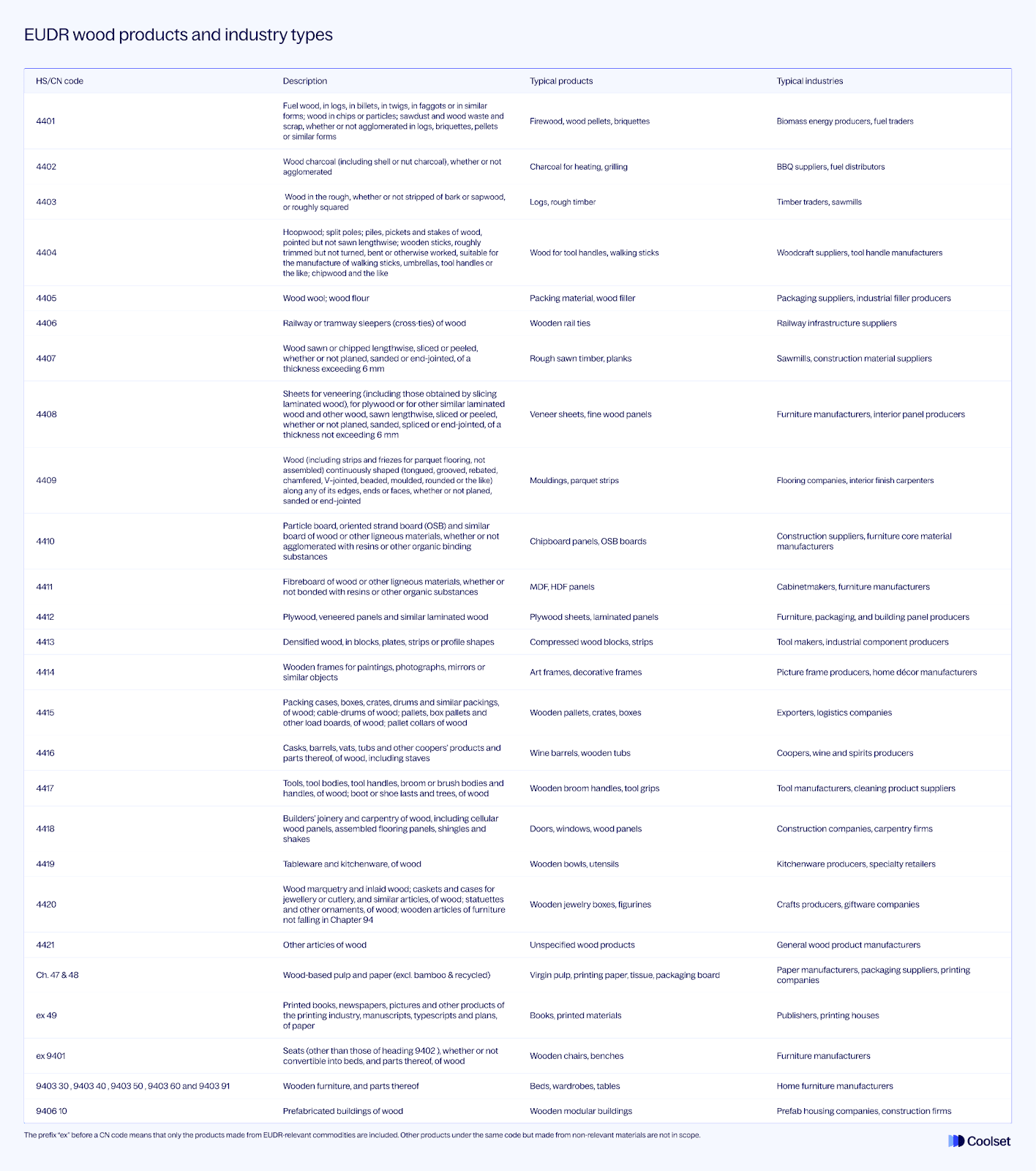
Wood is broadly covered under the EUDR, including raw materials like logs and fuelwood, semi-processed goods like sawn wood and panels, and manufactured articles like wood joinery and wooden packaging when sold as standalone products.
Products made of non-wood materials (like bamboo or rattan) are not included.
Sector nuance
For the timber sector, many companies are already familiar with legality checks from the former EU Timber Regulation (EUTR). But under EUDR, the bar is higher: products must also be proven deforestation- and degradation-free. This adds new complexity, especially around degradation, which is harder to assess and may apply even to selective logging.
Timber supply chains are also highly fragmented, often involving small or informal traders, which makes geolocation tracking and documentation more difficult to maintain.
Operators must also account for land type and land-use history. Wood may come from forests, plantations, or other wooded land. A plantation may be acceptable if it replaced non-forested land, but not if it was established through post-2020 forest clearance. Accurate land classification and historical data are critical.
Global footprint and production dynamics
Industrial, large-scale operations make up 48% of global forest plantations, while non-industrial plantations account for approximately 26%, according to the FAO. In terms of export value, major wood-producing countries include Brazil, China, Germany, Canada, the United States, Sweden, and historically, Russia
### Cattle
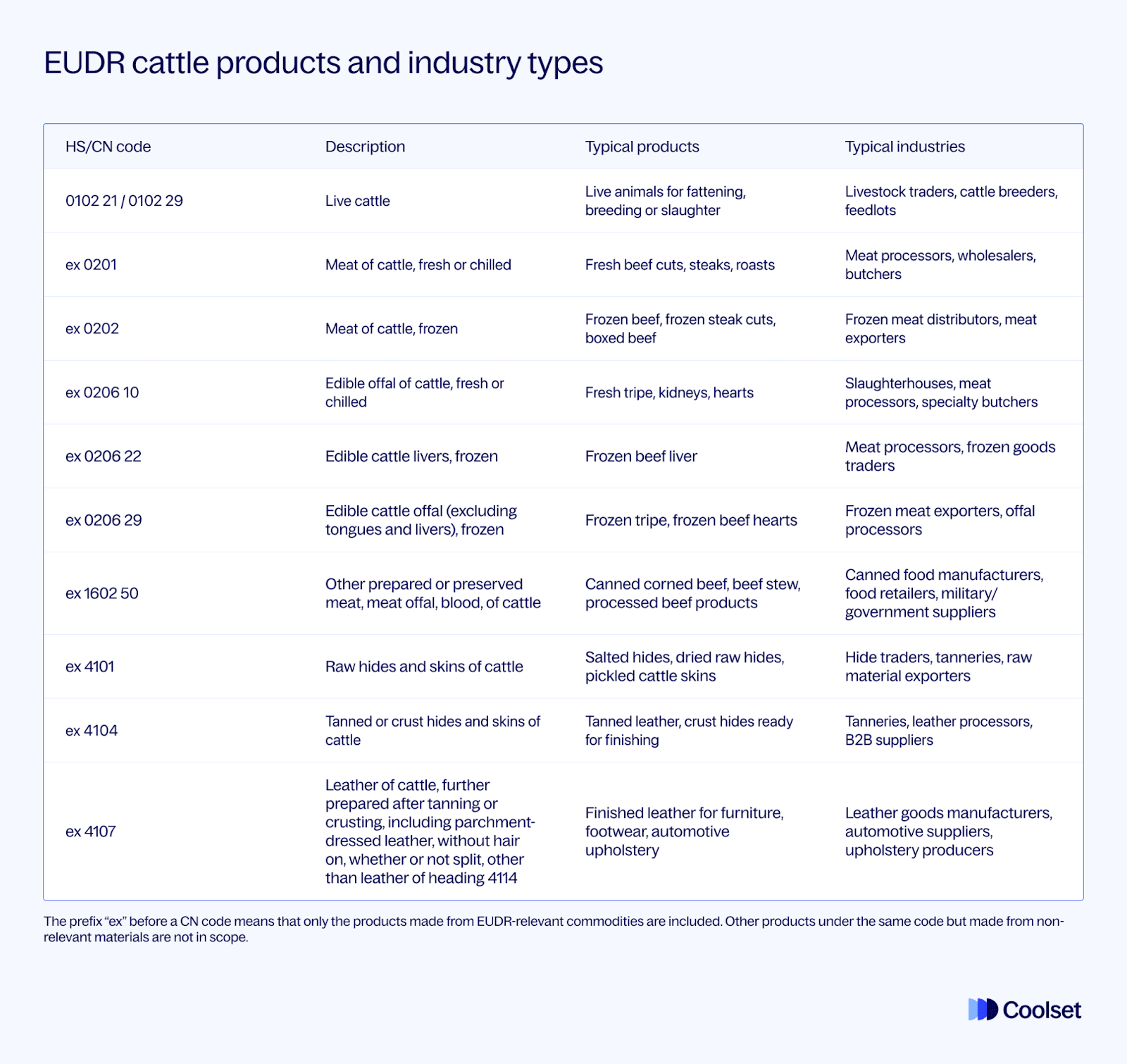
The EUDR applies to live cattle, beef, processed beef, and leather derived from cattle hides. These are among the highest-risk products due to their link to pasture-based deforestation.
Dairy and finished leather goods (e.g. handbags, shoes, car seats) are not in scope.
Sector nuance
For cattle, EUDR compliance requires full traceability across the animal's entire life, not just the final farm. Operators must document all plots of land where the animal lived, from birth through fattening and slaughter. This includes pasture, feedlots, and any changes in ownership. Partial records won't meet EUDR standards, which poses a challenge in regions with limited farm-level data systems or informal trading practices.
It's also important to note that EUDR doesn't stop with the animal. It includes deforestation risk in the feed supply chain. If cattle were fed soy, palm oil, or other in-scope commodities, and that feed is imported and placed on the EU market separately, it must also be covered by a due diligence statement. This makes it critical for vertically integrated supply chains to coordinate data across both livestock and feed systems, especially when sourcing from higher risk regions like Latin America.
Global footprint and production dynamics
Cattle production is fragmented across regions, with significant differences in farm scale and land use. In Brazil, which is the world's leading exporter, large-scale ranches, often exceeding 1,000 hectares, are common, especially in the Cerrado region. These operations are closely linked to deforestation. In Europe, by contrast, cattle farming primarily takes place on small to mid-sized farms. In many parts of Asia and Africa, large-scale ranching is rare; instead, smallholder farming dominates. This form of agriculture contributes to an estimated 70% of forest conversion in Asia and up to 95% in Africa. Overall, livestock farming remains the leading driver of global deforestation.
## Grey zones and exceptions to watch for
Even with a clear Annex I list, some product types sit at the edge of EUDR scope. These grey zones don't change the rules, but they do require extra attention to classification and context.
Composite products with multiple commodities
For products containing more than one EUDR commodity, only the commodity that determines the product's CN code is subject to due diligence.
Processed foods with minor commodity content
Many processed foods include small amounts of EUDR commodities but are classified under general food categories not listed in Annex I. For example, a biscuit containing cocoa nibs may fall under a bakery product code, not as a cocoa item placing it outside the scope.
Products made with EUDR commodities, but classified differently
The presence of an in-scope commodity doesn't determine coverage, classification does. A soap bar made with palm oil (CN 3401) is not included, as soap is not listed in Annex I. Similarly, leather handbags or shoes are typically classified under finished goods codes, not under the leather CN codes that are listed in the regulation.
Recycled or waste-derived products
The EUDR does not apply to products made entirely from recycled materials or classified as waste. This includes reclaimed wood, recycled rubber, second-hand leather goods, or antique furniture.
Re-exports
If you export a product covered by the EUDR, even one that was originally imported by someone else, you are still responsible for ensuring it's covered by a DDS. You may reference the original DDS if it is already available.
Packaging in or out?
Packaging is only in scope if it's sold or placed on the market as a product in its own right. A wooden pallet sold as packaging material (CN 4415) must meet EUDR requirements. However, the same pallet used solely for transporting goods is not regulated under the EUDR.
Printed goods removed from scopeRegulation (EU) 2025/2650 confirmed that all products under CN Chapter 49 (printed books, newspapers, periodicals, and other products of the publishing and graphic industries) are excluded from EUDR scope as of December 2025.
## What this means for your sector
Whether you trade in raw materials or finished goods, the EUDR's product scope directly shapes your compliance obligations. Understanding which of your products are in scope, and why, is the first step toward setting up a resilient, sector-specific compliance process. Our reporting guide for operators and SME reporting guide walk through the process step by step.
Start with CN code classification
Every product in your catalogue is classified under a CN (Combined Nomenclature) code. This classification determines whether a product is regulated under EUDR.
Cross-reference your product list against Annex I: if the CN code appears there, the product is in scope. If it doesn't, the regulation doesn't apply, even if the product contains cocoa, palm oil, leather, or soy or any other regulated commodity.
Tailor your risk approach to the commodity
Once you know what's covered, prioritize where the risks and data challenges are greatest. Each commodity brings its own supply chain complexity.
For example, palm oil may be traceable to a mill but not to a plantation; cocoa and coffee may rely on smallholder farms with no digital plot records; cattle need multi-location traceability and feed disclosures. Build these twists into your risk assessments and supplier onboarding, not as afterthoughts but as core workflows. See our EUDR risk assessment guide for a practical walkthrough.
Don't delay your data readiness
EUDR requires operators to collect detailed, georeferenced information for every in-scope product. This includes origin plots, harvest or production dates, supplier declarations, and justification for risk rating.
This isn't data you can assemble at the last minute. If you work across multiple commodities or sourcing regions, early planning is essential. Our guide on how to collect EUDR data from suppliers can help you get started.
Coolset can help
Coolset's EUDR solution helps companies collect the right data, check for deforestation risk, and file Due Diligence Statements without chasing suppliers or working in complex spreadsheets.
With Coolset, companies can import product and order data from your ERP, request documents from suppliers, and track everything in one place. The system flags missing or at-risk shipments and generates audit-ready DDS files that follow the mandatory EU TRACES format.
## July 2026 update: Annex I delegated act adopted — changes pending scrutiny
The Commission adopted the Delegated Act amending Annex I on 13 July 2026, alongside Implementing Regulation (EU) 2026/1565 on the Information System, turning the 4 May 2026 draft into a formal decision. It is not yet binding — the European Parliament and the Council now have a scrutiny period of typically two months during which either can object, after which the text is published in the Official Journal. The following changes were adopted.
Products removed from scope:
Cattle leather: raw hides (HS 4101), tanned hides (HS 4104), and further prepared leather (HS 4107) derived from cattle are deleted. Once in force, leather goods and leather supply chains will no longer fall under EUDR obligations.
Retreaded tyres: the full retreaded tyre category is narrowed to cover only tyre treads (HS 4012 90 30), rather than all retreaded tyres.
Soybeans for sowing, carved out of the broader soybean code due to separate certification and traceability systems.
Articles of vulcanised rubber and conveyor or transmission belts (HS 4010 and 4016), and aircraft and motor vehicle seats (HS 9401), all judged to contain too little of the regulated commodity to justify the compliance load.
Waste as defined under the EU Waste Framework Directive, across several rubber and wood/paper entries.
Items of correspondence, marketing materials, and catalogues from chapters 47 and 48 (paper and pulp).
Samples used for examination, analysis, or testing — including samples of negligible value used to solicit orders.
Products added to scope (compliance required from 30 December 2027):
Soluble coffee and coffee extracts, essences, and concentrates: HS 2101 11 00. This brings instant coffee within EUDR scope for the first time.
A range of palm oil derivatives spanning fatty alcohols, glycerol, specific acids, amines and soap forms across chapters 15, 29, 34 and 38 of the Combined Nomenclature, including HS 2916 15 for oleic, linoleic and linolenic acids.
Frozen cattle tongues: HS ex 0206 21 00.
The delegated act is adopted but not yet in force. The current Annex I as set out in Regulation (EU) 2023/1115 remains the binding list until the scrutiny period closes and the text is published in the Official Journal. Companies in affected sectors — particularly leather, coffee, and palm oil derivatives — should keep collecting due diligence data on removed categories until then. For the full breakdown, see EUDR product scope changes are official.
## FAQ - Common questions about EUDR product scope
### 1. What's the difference between FLEGT, EUTR, and EUDR?
The EUTR (EU Timber Regulation) was the previous framework governing timber imports. It required companies to prove the timber they imported was legal, but didn't cover deforestation or apply to other commodities. It also applied only to timber imported from outside the EU.
FLEGT is an EU licensing scheme under which timber exported from partner countries with a FLEGT agreement is considered legal. A valid FLEGT licence exempts the importer from conducting further legality checks but it only applies to certain timber sources.
The EUDR replaces the EUTR and goes further. For more detail on the transition, see our article on whether the EUTR still applies. It applies not only to timber, but also to cattle, soy, palm oil, cocoa, coffee, and rubber. And it adds a new requirement: products must not only be legal, they must be deforestation-free, meaning they were not produced on land deforested or degraded after 31 December 2020.
### 2. What are the EUDR compliance requirements?
While specifics vary by supply chain role, country of production, and company size, the general due diligence process includes:
Collecting key data for each product: CN code, commodity, geolocation of production, harvest date, quantity, supplier details, and proof of legality
Assessing the risk that the product is linked to illegal production or post-2020 deforestation (and degradation, in the case of timber)
Mitigating the risks if compliance cannot be confirmed e.g., by verifying documents
Retaining records of the above for at least five years
### 3. Is my product in scope if it contains palm oil?
Only if its CN code is listed in Annex I under the palm oil category.
Included among others:
Crude palm oil (1511)
Refined palm oil (1511)
Palm kernel oil (1513)
Palm oilcake (2306 60)
Oleochemicals like stearic acid, palmitic acid (3823), certain fatty acids and alcohols (ex 2915, ex 2905)
Note: The Commission adopted a delegated act on 13 July 2026 that adds a range of palm oil derivatives to Annex I, including soap forms, fatty alcohols, glycerol and specific acids. It is not yet in force, pending Parliament and Council scrutiny. Monitor official Commission updates for confirmation.
Not included among others:
Soap containing palm oil (3401)
Food products like margarine, instant noodles, or snacks using palm oil as an ingredient
Cosmetics using palm derivatives unless the product itself is listed
Detergents or biodiesel unless covered under a listed CN code (currently rare)
The key test is not whether palm oil is present, but whether the product falls under a CN code listed in Annex I. If it doesn't, the product is out of scope.
### 4. What's the latest list of regulated products?
The most up-to-date list of EUDR-regulated products is in Annex I of Regulation (EU) 2023/1115. It lists the CN codes that determine whether a product is in scope, grouped by commodity. You can access the list via EUR-Lex. The European Commission adopted a delegated act on 13 July 2026 adjusting product scope, removing cattle leather and adding products such as soluble coffee and palm oil derivatives. It is not yet in force, pending Parliament and Council scrutiny. The Commission published the draft as part of the May 2026 simplification package – see our EUDR simplification 2026 article and the July 2026 adoption breakdown for full detail.