Navigating the VSME Basic Module: A practical guide
The VSME standard is a sustainability reporting standard for micro, small and medium enterprises (VSMEs) comes in.
Read the full introduction
The VSME standard is a sustainability reporting standard for micro, small and medium enterprises (VSMEs) comes in. This article provides guidance on the VSME Basic Module that enables businesses to track ESG progress without unnecessary complexity.

Key takeaways
- The VSME Basic Module covers ~50 essential ESG data points across energy, emissions (Scope 1 and 2), workforce, health and safety, fair wages and anti-corruption.
- Completing the Basic Module is required before opting into the Comprehensive Module, making it the starting point for any company adopting the VSME framework.
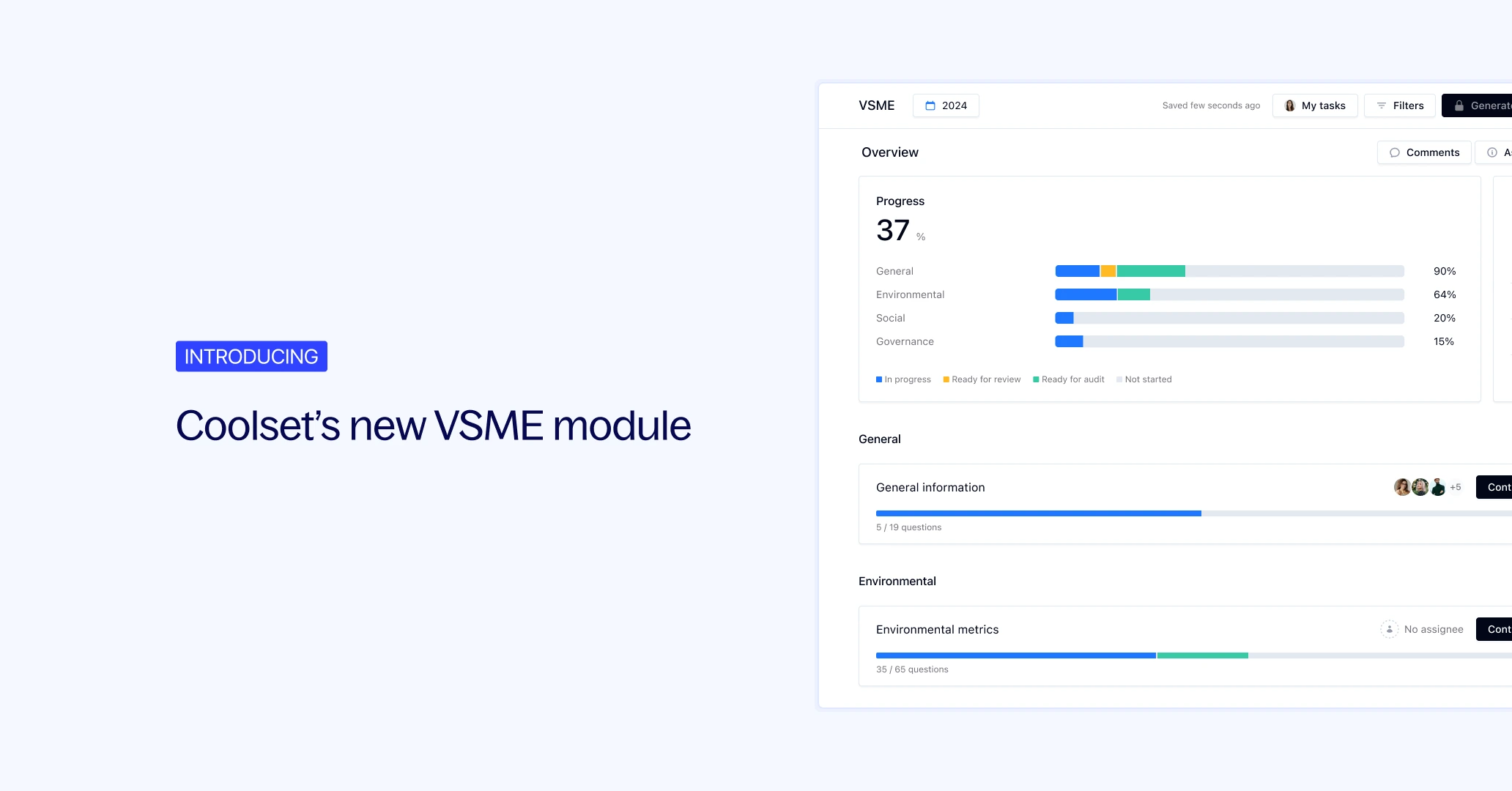
- Coolset's VSME module guides teams through every Basic Module data point with structured workflows and automated reporting.
With the Omnibus proposal reshaping ESG reporting obligations, many companies that previously had to comply with the Corporate Sustainability Reporting Directive (CSRD) may no longer be required to report. But while mandatory requirements are loosening, the ESG reporting environment only grows in importance.
For businesses that want to continue structured ESG reporting without the complexity of full CSRD alignment, the VSME standard provides an efficient, proportional, and practical framework. It allows companies to measure, track, and communicate their sustainability performance — without unnecessary administrative burdens.
The VSME standard is designed to offer businesses a flexible, proportional approach to ESG reporting, with two levels of disclosure:
Basic Module: A streamlined ESG report that covers core sustainability metrics, such as energy use, workforce structure, wages, and anti-corruption compliance. This module is ideal for businesses looking for a manageable, lightweight ESG framework that meets basic stakeholder expectations without excessive complexity.
Comprehensive Module: A more detailed ESG report that builds on the Basic Module, adding disclosures on strategy, climate transition, human rights, and sector-specific data. This module is suited for companies that want to enhance transparency for banks, investors, and business partners.
Why start with the Basic Module?
The Basic Module is the starting point of VSME reporting. It provides a practical entry point for companies that are new to structured ESG reporting or seeking an alternative to CSRD compliance. Businesses must complete the Basic Module before opting for the Comprehensive Module, ensuring a structured, step-by-step approach to ESG reporting.
Why companies are choosing the VSME Basic Module
The Omnibus proposal gives companies more flexibility in how they approach ESG reporting. As a result, businesses now have three options:
Mandatory CSRD – Large companies with 1,000+ employees remain fully within CSRD’s scope and continue compliance.
Voluntary CSRD – Mid-sized companies committed to structured sustainability reporting choose to maintain CSRD alignment.
VSME Basic Module – Smaller organizations or those seeking a more practical, cost-effective ESG framework transition to the VSME.
For many businesses, the Basic Module is the ideal starting point. It mirrors key CSRD principles but removes unnecessary complexity — providing a credible, standardized approach to sustainability reporting.
What is the VSME Basic Module?
The VSME Basic Module is the core part of a framework developed by EFRAG, designed to help businesses disclose their most essential sustainability information. It aligns with the European Sustainability Reporting Standards (ESRS) but is structured to be more concise, proportional, and business-friendly.
The Basic Module includes around 50 key ESG data points, covering:
- General company information
- Environmental performance (energy use, GHG emissions, waste management)
- Social performance (workforce structure, wages, diversity, and safety)
- Governance (anti-corruption and compliance measures)
It’s ideal for businesses that want to track their ESG progress, meet stakeholder expectations, and prepare for future regulatory shifts — without overloading internal resources.
Who should use the Basic Module?
Your company should consider adopting the Basic Module if:
- You want to align with European ESG standards but in a proportional and manageable way.
- You need to provide ESG data to banks, investors, or large business partners that require sustainability disclosures.
- You are part of a supply chain that prioritizes ESG transparency and want to ensure continued business partnerships.
- You want to future-proof your business and position yourself for long-term sustainability success.
- You need an ESG framework that scales — starting with core disclosures and expanding over time.
What’s inside the Basic Module?
The Basic Module is structured into four key ESG categories, each containing essential sustainability disclosures:
General information
- Business structure and legal form
- Sector classification (NACE codes)
- Workforce size and geographical operations
- Whether the report is individual (business-only) or consolidated (includes subsidiaries)
- Details of any sustainability-related certifications or labels
Environmental metrics
- Energy use & GHG emissions (excluding Scope 3)
- Total energy consumption (MWh)
- Breakdown by renewable vs. non-renewable sources
- Scope 1 emissions (direct emissions from company-owned sources)
- Scope 2 emissions (indirect emissions from purchased electricity, heat, or cooling)
- GHG intensity (emissions per euro of turnover)
- Pollution
- Only required if legally obligated or voluntarily monitored
- Emissions to air, water, and soil
- Biodiversity impact
- Number and area (in hectares) of business sites near biodiversity-sensitive areas
- Water management
- Total water withdrawal
- For water-intensive industries: disclosure of water use in high-stress areas
- Resource use & circular economy
- If applicable: use of circular economy principles
- Waste generation (hazardous and non-hazardous)
- Percentage of waste recycled or reused
Social metrics
- Workforce structure
- Number of employees by contract type (permanent vs. temporary)
- Gender breakdown
- For companies with 50+ employees: Employee turnover rate
- Health & safety
- Work-related accident rate
- Number of work-related fatalities
- Fair wages & workforce development
- Whether employees earn at least the legal minimum wage
- Required for companies with 150+ employees, lowering to 100 in 2031: Gender pay gap
- Percentage of employees covered by collective bargaining agreements
- Broken down by gender: Average number of training hours per employee
Governance metrics
- Anti-corruption & bribery compliance
- Number of corruption or bribery convictions in the reporting period
- Total amount of fines incurred

How to get started with the Basic Module
Step 1: Collect your ESG data
Start with readily available business records:
- Energy bills: For energy use & emissions reporting
- Payroll records: For workforce size & wages
- Health & safety logs: For accident reporting
- Waste & water bills: For environmental impact tracking
- Company policies: For governance & ethical disclosures
Tip: If exact data isn’t available, estimates are acceptable — the framework is designed to be realistic and flexible.
Step 2: Report & share your ESG data
Decide how to present your Basic Module report:
- Internal reporting – For management, board members, and stakeholders
- ESG disclosures for investors, banks, and business partners
- Public sustainability reporting (optional) – On your website or in corporate reports
What’s next?
Investors, banks, and large business partners still expect sustainability data, and having a structured ESG report helps you build trust, secure financing, and future-proof your organization. The VSME standard provides a manageable, actionable framework that allows businesses to transparently report on ESG performance without excessive complexity.
To guide this process, Coolset has launched a dedicated and modular VSME module: starting with the Basic framework and extending into Comprehensive. It’s designed to streamline reporting while setting you up with an end-to-end sustainability management platform for both current and future ESG needs.
Want to learn more? Find a time with our team.