Coolset website previewWhat we’re building
The Coolset design language

A stronger reading experience

Three directions that work together. The aim is a useful enterprise publication: clear to read, easy to verify, and simple to navigate.

The recommended reading treatment now applies to Academy articles. These examples let you compare its parts.

The foundation

Editorial clarity

A shorter display headline, stronger reading type, a quieter cover, and a clear byline.

For credibility

Evidence first

An executive summary, useful evidence tables, and sources beside the content that they support.

For long guides

Guided reading

A chapter guide that follows your place, clear section breaks, and a relevant next step.

Compare the same article

The sample uses published text, a table, and the recorded author and date. The display headline is shortened for this proposal.

Choose a design treatment

Editorial clarity. Start with a readable publication. Give the title, author, and reading column a deliberate hierarchy.

Evidence first. Make the useful detail easier to find. Show the existing summary, an evidence table, and its source.

Guided reading. Keep your place in a long article. The chapter guide follows the section that you read.

My recommendation. Use editorial clarity everywhere. Add evidence blocks where they help. Use the chapter guide for longer articles.

Preparing EcoVadis
supporting documents

Practical guidance for sustainability and compliance teams.

Preparing EcoVadis supporting documents: A complete guide for sustainability & compliance teams - Coolset
At a glance

Key takeaways:

  • EcoVadis documentation is a team effort – procurement, HR, compliance, and sustainability all play a role.
  • Evidence must be recent, relevant, and verifiable – policy alone isn’t enough to earn points.
  • Coolset helps by organizing ESG data, tracking policy updates, and automating document workflows across frameworks.

EcoVadis assessments are built on evidence – not intentions. Having a policy in place isn’t enough to secure a strong score. What matters is whether that policy is credible, current, and backed by proof that it’s being used in practice.

This guide provides an end-to-end, practical guidance for preparing strong EcoVadis supporting documents. It’s designed for sustainability, procurement, and compliance teams looking to avoid common mistakes, streamline collaboration, and present evidence that reflects the real strength of their sustainability programs.

Evidence by theme

The published guide brings the document types into one reference table.

Theme Policies Procedures / actions KPIs / results Certifications / audits
Environment Environmental policy with targets, signed & dated Energy management plans, waste procedures, EMS manuals CO₂e data, energy use, water consumption, waste KPIs ISO 14001, CDP scores, environmental audits
Labor & human rights Human rights policy, Code of Conduct H&S procedures, grievance mechanisms, diversity protocols Accident rates, turnover, satisfaction metrics ISO 45001, SMETA or SA8000 audits
Ethics Code of Ethics, anti-corruption policy Speak-up procedures, conflict of interest management % of employees trained, ethics hotline usage stats ISO 37001, ethics audit reports
Sustainable procurement Supplier Code of Conduct, procurement policy Supplier risk assessment process, audit workflows % of suppliers audited or signed to code Supplier ISO 14001/45001 certs, SMETA reports
Table from the full Coolset Academy guide. Scroll horizontally to read every column on a smaller screen.

Build a repeatable workflow

Preparing for EcoVadis doesn’t need to be a last-minute scramble. With a few smart habits and tools, you can build a repeatable process that saves time – and improves results.

Start early and assign ownership

Treat EcoVadis like a project. Form a small taskforce as soon as you know the deadline – typically involving sustainability, HR, procurement, compliance, and EHS teams. Map each EcoVadis theme to an internal owner (e.g. labor to HR, ethics to legal). Set deadlines and hold people accountable. Export the question set from EcoVadis to Excel and use it as a checklist for assigning responsibilities.
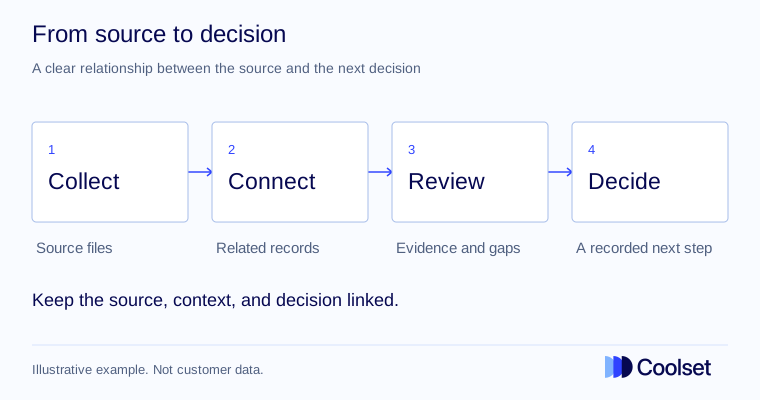
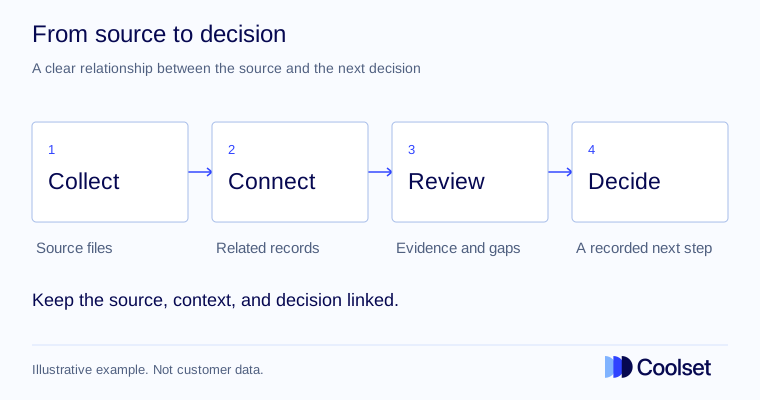
Illustrative workflow: collect source files, connect related records, review evidence and gaps, then record a next step. This is a conceptual diagram, not a product screenshot.
Illustrative example. Not customer data.Download SVG
Your next step

Put the guidance to work

Explore how Coolset supports your EcoVadis assessment.

Explore EcoVadis

Combine the useful parts

Use editorial clarity as the default. It improves every article without requiring more content work.

Add evidence blocks where the subject needs them. Use sources, tables, diagrams, and attributed expert context. Avoid decorative statistics.

Add guided reading to long articles. Keep the chapter guide and next action useful. Short updates can stay simple.

Return to the brand direction