Your CSRD software buyer's guide
Following the December 2025 Omnibus changes, CSRD now applies only to companies with more than 1,000 employees and €450M+ turnover, with reporting starting in 2027 and simplified ESRS standards expected mid-2026.
Read the full introduction
Following the December 2025 Omnibus changes, CSRD now applies only to companies with more than 1,000 employees and €450M+ turnover, with reporting starting in 2027 and simplified ESRS standards expected mid-2026. For companies still in scope, the challenge is no longer whether to prepare, but how to do so efficiently across overlapping ESG frameworks like CSRD, EU Taxonomy and CDP. This guide explains why large enterprises need integrated ESG platforms instead of single-framework tools, what capabilities to prioritise, and how to avoid costly software missteps.
Key takeaways
- CSRD scope has narrowed significantly, but in-scope enterprises still face complex, overlapping ESG requirements that demand structured preparation before 2027.
- The right ESG software should combine regulatory compliance, carbon management, supply chain engagement and automation in one scalable platform, not siloed CSRD-only tools.
- Coolset provides an integrated ESG platform updated to reflect the Omnibus changes, helping enterprises stay compliant while reducing duplication and manual work.
In December 2025 the Omnibus proposal was accepted, drastically narrowing the scope of CSRD. Now, only companies with over 1000 employees and turnover beyond €450M must comply with this EU regulation. Additionally, the ESRS datapoints have been redrafted, suggesting a significant reduction in datapoints. These still have to be approved with a delegated act, which is expected to happen mid-2026.
From 2027, large, in-scope companies are expected to comply with CSRD, which raises the question: what is the most efficient way to prepare for compliance? Whether you're new to sustainability reporting or just looking to streamline the process, having the right CSRD software in place is crucial.
This guide will walk you through why you need CSRD software, what it does, and how to choose the best solution for your business.
Who needs CSRD compliance software after the Omnibus changes?
The Omnibus proposal establishes a dual threshold for companies to be in scope. Companies have to comply with CSRD if they have more than 1000 employees and their turnover exceeds €450M. These new thresholds result in approximately 90% of the originally scoped companies now being exempt from mandatory compliance. ESRS also saw major reduction in datapoints, with 61% of the previous datapoints being scrapped.
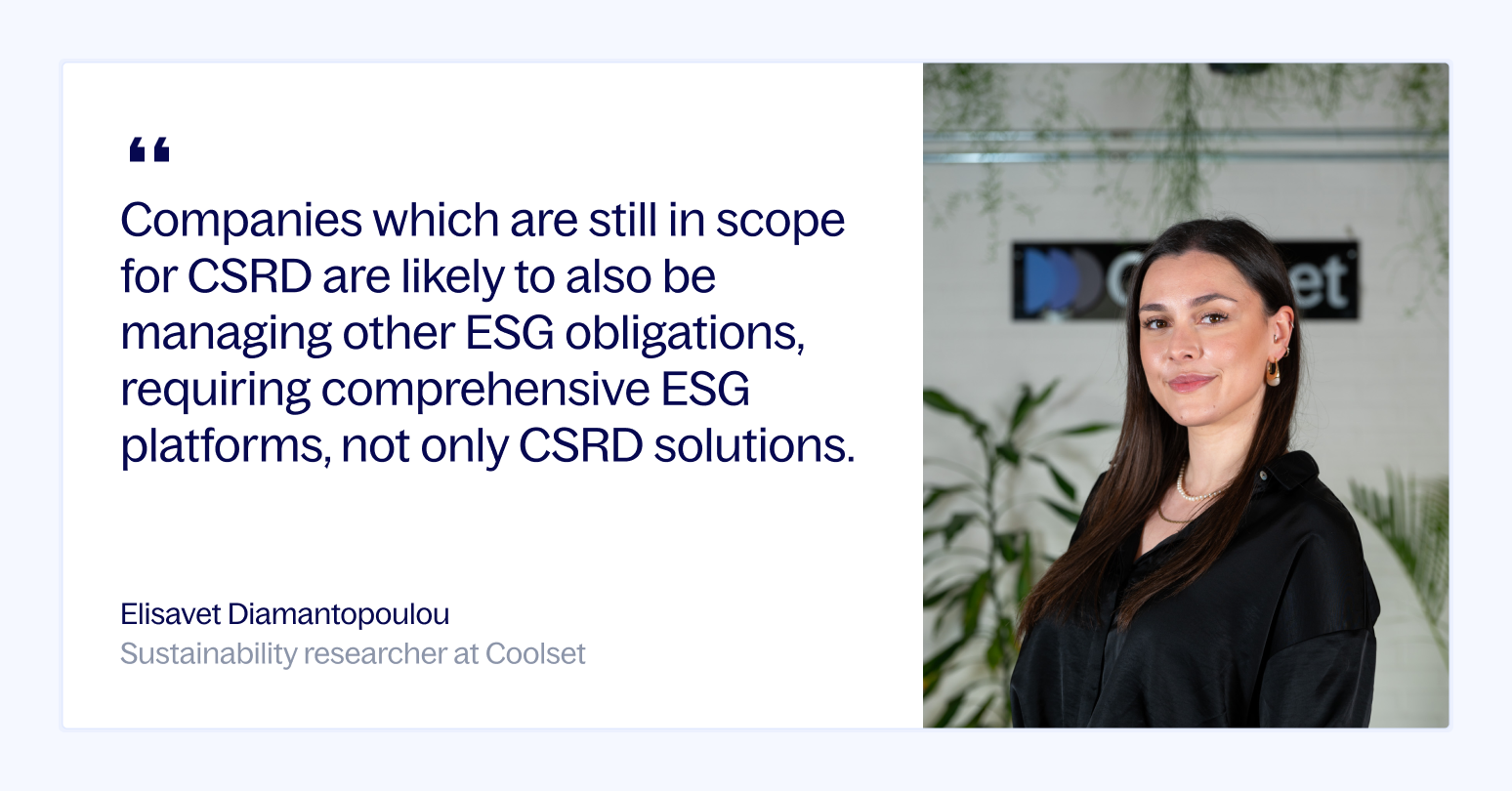
The final delegated act outlining the final ESRS is expected mid-2026, giving companies some time to prepare strategically. First reporting will start in January 2027, with waves 2 and 3 being postponed an additional two years. Wave 2 will begin reporting in January 2028 and wave 3 in January 2029. Companies which are still in scope for CSRD are likely to also be managing other ESG obligations, requiring comprehensive ESG platforms, not only CSRD solutions.
Why large enterprises need integrated ESG platforms (and not just CSRD tools)
Businesses use ESG software to simplify every part of their sustainability reporting process, making it easier to meet the requirements of the CSRD. Here's are some of the capabilities you can expect:
- Managing ESG data and staying compliant with regulations
- Measuring and reducing carbon emissions
- Tracking progress on sustainability goals
- Evaluating progress against emission scenarios
- Managing sustainability efforts across the supply chain
- Preparing for audits and creating clear reports
- Identifying and minimizing sustainability risks
- Benchmarking performance against industry standards and best-practices
- Communicating progress with stakeholders
Large enterprises in scope for CSRD after Omnibus are very likely to face overlapping ESG obligations. Companies have to work towards standards and regulations such as CSRD, CDP, EU Taxonomy and GRI simultaneously. By turning to a comprehensive ESG platform which addresses multiple of these requirements, you can save your sustainability team valuable time spent duplicating data across platforms and cross-checking requirements.
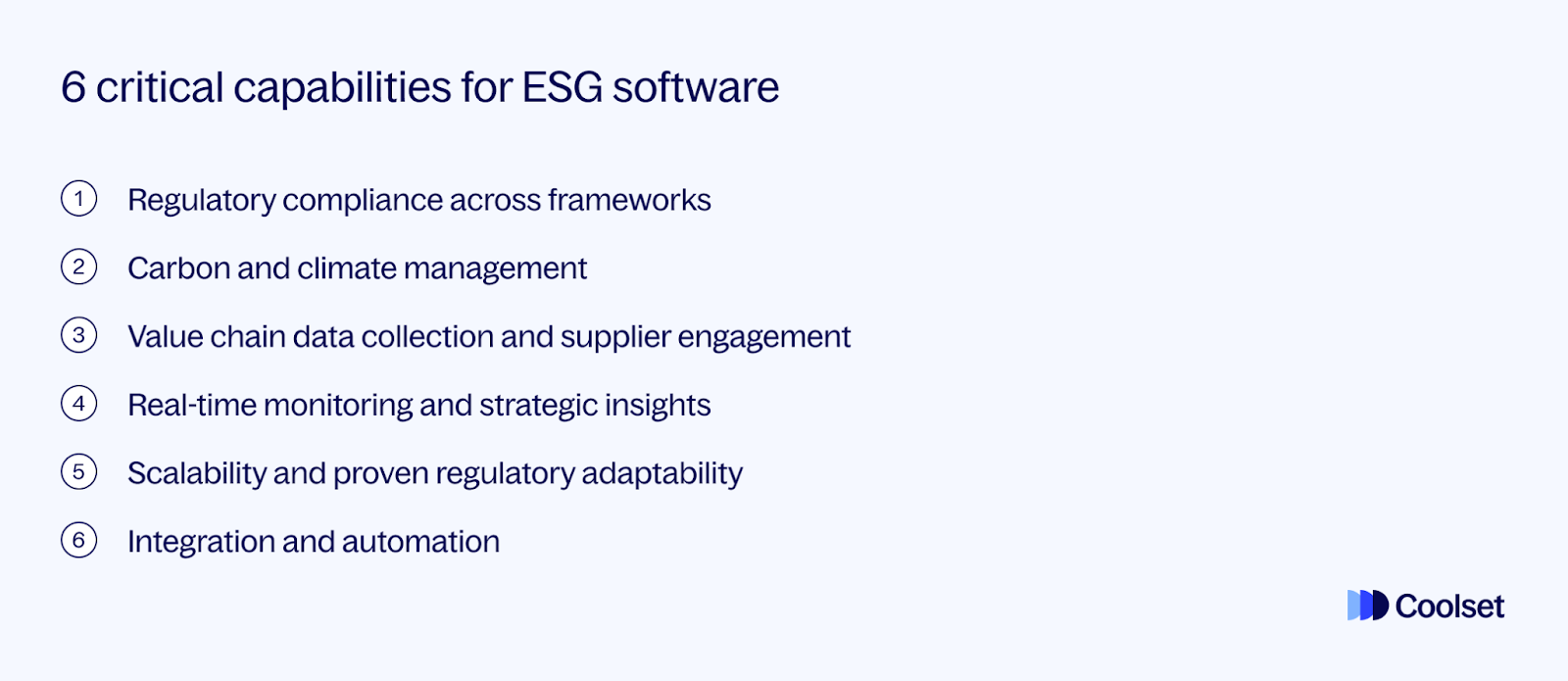
6 critical capabilities for enterprise ESG software
- Regulatory compliance across frameworks: comprehensive ESG software has extensive background across various ESG frameworks, facilitating compliance with various standards at once. This eliminates duplicate data entry and assures that documentation for audit is verified. Software can automatically detect missing or inconsistent data, leading to higher quality, more thorough results.
- Carbon and climate management: ESG solutions can store scope 1-3 emissions data, with scope 3 divided into the required categories, in alignment with the GHG protocol. Science-based target (SBTi) tracking and validation tools can help your company monitor progress towards targets and against a transition plan.
- Value chain data collection: value chain data collection is one of the most complex parts of CSRD compliance. Supply chain engagement and data collection require systematic processes for gathering sustainability data from upstream and downstream value chains. Look for a platform which integrates the supply chain and engages with suppliers in the interface.
- Real-time monitoring and strategic insights: live carbon and ESG data dashboards give a clear overview of progress. This facilitates benchmarking against industry peers and highlights best practices. Tools with integrated double materiality capabilities support the intersection between impact and financial materiality, further deepening the value of ESG tracking. A platform that offers strategic insights as well as data overviews allows you to align your data with your strategy, generating tangible results.
- Scalability and proven regulatory adaptability: the EU regulatory landscape continues evolving and changing constantly. It is essential that your chosen software solution has responded quickly to regulatory changes in the past year, to ensure they have a proactive approach to regulatory changes. Platforms with a transparent product roadmap which includes regulatory updates and uncertainties demonstrate a commitment to staying up to date. Finally, customer success should bring regulatory expertise and not just technical support.
- Integration and automation: seamless integration between various different data sources is essential for efficient ESG data management. Platforms with built-in connectors to common systems such as energy management, logistics and financials eliminate manual data transfers which could cost time and result in mistakes. Automated elements, such as quality checks and automatic calculations can quickly identify which data still requires additional attention before reaching compliance.
Red flags when evaluating ESG platforms in 2026
When trying to find a software solution that works for your ESG requirements and company there are several signs that might mean a solution is not the best for your needs.
- Be cautious of premium pricing for regulation and features which have been postponed, as these indicate platforms which are selling regulatory uncertainty, rather than genuine value.
- If a platform does not mention supply chain engagement capabilities as part of its value chain offering, it implies that they have not sufficiently addressed the complexities of upstream and downstream data collection, which is critical for CSRD.
- Single-framework solutions focused exclusively on CSRD will create data silos and result in unnecessary time spent on data entry.
- Rigid contracts without consideration of regulatory updates can make you vulnerable as standards continue evolving and should be avoided. Instead, ensure that your agreement includes flexibility for platform changes in regulatory uncertainty.
- Providers making vague “AI-powered” claims without providing specifics on the AI integrations in their software are likely just using buzzwords rather than delivering functional automation features.
Generally, try to look for evidence that platforms have responded quickly to the Omnibus changes, as this indicates you are dealing with a leader in the sector.
How Coolset supports post-Omnibus enterprise sustainability
Coolset offers a comprehensive ESG platform with frameworks such as CSRD, carbon management, supply chain and EU Taxonomy. Since the Omnibus proposal, Coolset has updated their CSRD product and amended the ESRS datapoints to reflect the most updated version. Using certified methodology and with vetted audit networks, Coolset continues to integrate changing regulations, so that the platform is always up to date.
FAQ
Does my company still need CSRD software after Omnibus?
If you have more than 1000 employees AND turnover exceeding €450M, you are still in scope for CSRD. Listed SMEs and smaller companies are exempt.
How many datapoints under simplified ESRS?
The amended ESRS contains 400-500 datapoints, a stark reduction from the previous 1100+ datapoints. Final numbers have yet to be confirmed, with final approval expected mid-2026.
When does the new scope take effect?
Reporting starts from January 1st 2027. Waves 2 and 3 have been postponed two additional years.
What is supplier engagement?
It refers to communicating and collecting data from companies in your value chain. CSRD requires companies to gather ESG information from their upstream and downstream partners to report on scope 3 emissions and other impacts. Since a large part of sustainability impacts occur in the supply chain rather than operations, effective supplier engagement is essential for accurate CSRD reporting.
Should I wait until mid-2026 to choose software?
No, but you should choose a vendor with proven agility surrounding the regulation. Choosing a vendor which has not proven that they can adapt quickly to changing regulations makes you vulnerable to poor functionality increasing your own workload.